
Today I’m going to tell you what can be called the best affordable dog food. Some people think that an affordable brand is automatically the best, but that’s not true. Affordable dog food is the one that your dog happily eats and stays healthy after eating it. That’s what I believe.
In the UK, every dog food brand claims to be the best: the best ingredients, the best value, the best for your dog. If you go to a pet food shop, you’ll see one word everywhere on dog food bags: best. But none of them tells you what “best” actually depends on when it comes to what your dog is eating, and no brand really knows your dog.
I learned this the slow way, through a lot of trial and error with my own dog. This article is what came out of that.
Key takeaways
- The brand isn’t the deciding factor. Whether your specific dog eats the food properly and keeps eating it is.
- A food matching its own label, doing what it claims, matters more than how it’s marketed.
- Price and quality aren’t the same thing. Plenty of affordable food is genuinely complete and balanced.
- I feed Wagg, not because it’s the most popular brand, but because it’s the one my dog actually does well on.
The Problem Was Never the Brands
When I started looking into dog food properly, I assumed the difficulty would be finding a “good” brand. It wasn’t. There are dozens of decent brands in the UK, and most of them are honestly fine.
The actual difficulty was different. My dog wasn’t eating properly. He’d already been a picky eater before I really understood what I was doing, and no amount of brand reputation fixed that on its own.
I tried several well-known brands, the ones that show up on every “best dog food” list, the ones with the glossy packaging and the confident marketing. Some of them he barely touched. Others he ate for a few days and then stopped. It wasn’t that the food was bad. It just wasn’t right for him specifically.
That’s the part most brand comparisons skip over entirely. They rank foods against each other as if one formula could objectively beat another for every dog, everywhere. It doesn’t work that way. A food is only as good as what it actually does once it’s in front of your dog.
Why Affordable Dog Food UK Matters More Than Ever
To tell you the truth, I know that the cost of keeping a dog has increased a lot. It is not easy to give them proper food at the right time for a dog’s health. For some reason, sometimes we compromise on dog food, but saving too much on food can be expensive later. Poor quality cables often result in more vet visits, such as digestive issues, diarrhea or skin problems. That is why the main thing is to find value.
Find the right quality at a low price. It is not that you will not get the right quality of dog food at an affordable price, but you should find it. You should know what quality dog food is so that you can analyze whether this dog food will be right for my dog or not.
Such food that has decent meat content, no unnecessary fillers and has a proper balance that fits a realistic budget.
What Actually Decides If a Food Is “Best”
After going through that process, I ended up with a much simpler way of judging food than any star rating or brand comparison gives you.
Does your dog eat it properly, and keep eating it, not just for the first bowl but consistently? Does what’s on the label match what actually happens once your dog’s eating it, meaning are the ingredients doing what they claim, not just sounding good on paper? Does it fit what you can actually afford long-term, since a food you can’t keep buying isn’t a solution, it’s a temporary fix?
Every one of those questions is specific to your dog and your situation. None of them can be answered by a brand’s marketing copy, however well written it is.
That’s really the core of it. The problem isn’t the brands. Most reputable UK dog food brands make a complete, balanced product. The problem is finding which one is actually right for your dog, and that takes testing, not trusting a label alone.
My Story With Wagg
I’ve mentioned this before, but it’s worth laying out properly here, because it’s the whole reason I trust this food the way I do.
My dog had trouble with food early on. He was already a fussy eater by the time I really started paying attention, and I didn’t have much background in dog nutrition at that point. So I did what most owners do. I tried different brands, one after another, hoping one would just work.
Some of the popular, well-reviewed brands didn’t suit him at all. Either he wouldn’t eat them consistently, or something about them didn’t agree with him. I want to be clear here: I don’t think those brands are bad. They just weren’t right for my dog specifically, and that’s an important distinction.
Eventually I tried Wagg. Not because it was the cheapest, though it happens to be affordable, but because at that point I was just trying things to see what would actually work. He ate it properly. He kept eating it. And he’s been eating it, or products from the same range, ever since.
I’ve recommended it to friends and family who were dealing with similar fussy-eating situations, and they’ve had good results too. But I want to be honest about why I recommend it. It’s not because Wagg is objectively “the best” dog food in the UK. It’s because it’s the one that actually worked, consistently, for my dog. That’s a different claim, and it’s the only one I’m actually qualified to make.
What “Affordable” Actually Means
Cheap and low-quality aren’t the same thing, and expensive and high-quality aren’t automatically the same thing either. A complete food, meaning one labelled to provide everything your dog needs as their whole diet, can sit at either end of the price scale and still genuinely do the job.
What separates a good budget food from a false economy isn’t the price tag. It’s the ingredient list, and a few label habits make that easier to check.
Look at whether meat is named or vague. “British chicken 26%” tells you something concrete. “Meat and animal derivatives” as the first ingredient doesn’t tell you what’s in the bag or how much of it there actually is.
Check “with” against “flavoured.” Food labelled “with chicken” legally has to contain at least 4% chicken. “Chicken flavoured” doesn’t have to contain any chicken at all. It’s a small wording difference, but it changes what you’re actually paying for.
Make sure it’s labelled complete, not complementary. Complementary foods are designed to be fed alongside something else, not as a full diet on their own, and feeding one as your dog’s sole meal can leave real nutritional gaps over time.
Signs the Food Is Actually Working
This is the part that matters more than any brand comparison, and it’s specific to your dog, not something a review article can tell you in advance.
Firm, well-formed stools are one of the clearest signs. If your dog’s stools are consistently loose, very smelly, or unusually large in volume, the food isn’t agreeing with them, whatever the label promises.
A steady energy level matters too, along with a coat that stays reasonably shiny rather than dull or flaky. Weight that holds steady, rather than creeping up or down without any change in portions, is another practical marker.
And the simplest one: does your dog actually want to eat it. Enthusiasm at mealtimes is a real signal, not something to dismiss as unimportant.
If any of these go the wrong way after switching food, that’s useful information. Don’t ignore it because the brand has good reviews online. Your dog’s reaction outweighs anyone else’s.
Best Affordable Dog Foods in the UK
Wagg Complete
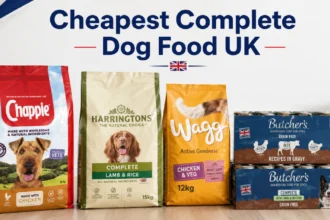
This is what I feed. It’s one of the more affordable branded complete foods sold in the UK, and it’s held up well over a long stretch of feeding it to my dog. The ingredient list leads with cereals rather than a named meat as the very first item, so it’s a genuinely budget-tier formula rather than a premium one at a lower price. For a dog with a diagnosed protein allergy, it’s not the right choice. For a dog without known sensitivities who just needs a dependable, affordable food, it’s done exactly what I need.
Harringtons Lamb and Rice
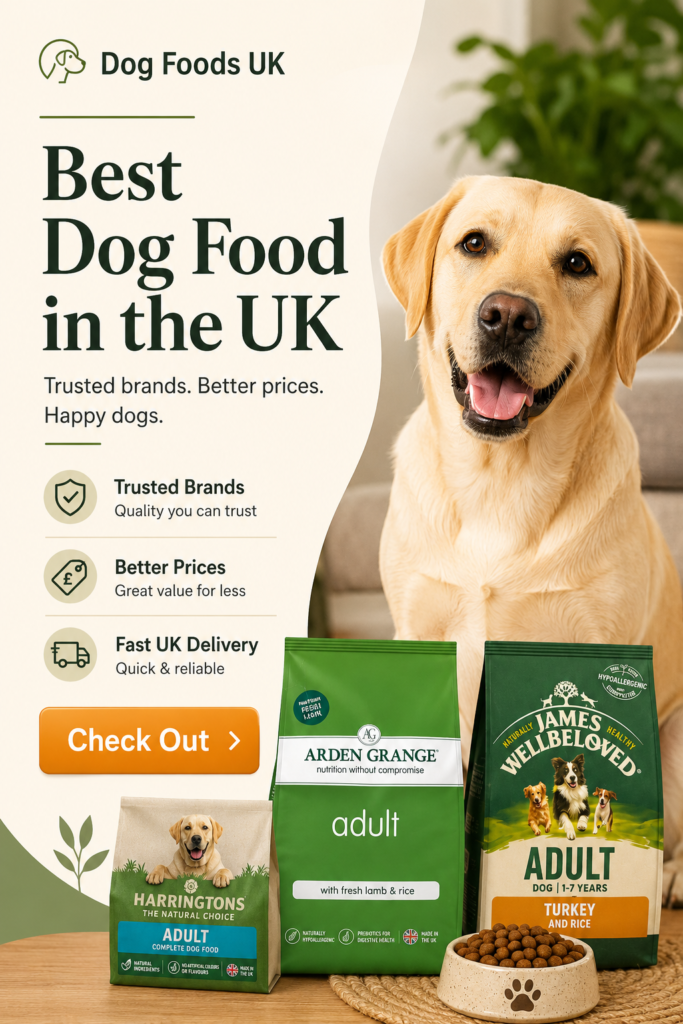
A step up in price from Wagg, with a named meat source rather than a generic one. Good for owners who want a bit more ingredient transparency without moving into premium pricing. It’s widely available in supermarkets, which matters if you’d rather not rely on deliveries.
Skinner’s Field and Trial
Originally developed for working dogs, which is actually the reason it’s cheaper. Food marketed for working dogs qualifies for zero-rated VAT under UK tax rules, unlike food marketed as a general pet product. It’s calorie-dense, so it suits active or larger dogs well, but it can be too rich for a sedentary smaller dog if portions aren’t adjusted.
Aldi Earls / Lidl Orlando
Supermarket own-brand food deserves more credit than it usually gets. Both have performed reasonably in independent nutritional comparisons and tend to be the cheapest complete option on the shelf. Good for a healthy dog with no known sensitivities and the tightest possible budget. Ingredient transparency runs lower than branded budget foods, so if your dog has any known issues, this isn’t where to experiment.
Autarky Adult
Sits between the cheapest options and mid-tier brands. Larger pack sizes bring the per-kilo cost down further, and it’s generally well regarded for digestion and coat condition. A reasonable step up from the absolute cheapest option without moving into premium pricing.
How to Actually Test a Food, Rather Than Guess
Given everything above, guessing isn’t really necessary. There’s a simple, low-risk way to find out if a food will work for your dog before committing to a large bag.
Start with the smallest available bag size, even if it costs slightly more per kilo, since you’re paying for information at that stage, not value. Transition gradually over 7 to 10 days, mixing the new food with whatever your dog was eating before, since a sudden switch can cause digestive upset that has nothing to do with whether the food itself is right.
Then give it two to three full weeks before judging the result. Stool quality, coat, and energy all take time to settle into a new pattern, and judging too early is one of the most common mistakes owners make when comparing foods.
Ways to Save Without Downgrading
Buying larger bags almost always brings the per-kilo cost down, provided you can store the food properly and get through it before it goes stale. Loyalty schemes, Tesco Clubcard, Pets at Home’s VIP club, chip away at the cost over time, and Amazon’s Subscribe & Save option works out genuinely cheaper on brands like Wagg and Harringtons specifically.
None of these require compromising on what you actually feed your dog. They just reduce what you pay for the same bag.
Frequently Asked Questions
Is affordable dog food nutritionally complete?
Yes, provided the label says “complete.” Budget and premium complete foods both have to meet the same baseline UK nutritional standards. The real difference tends to be ingredient sourcing and quality, not whether the nutrition itself is adequate.
How do I know if a cheap food is actually working for my dog?
Watch stool quality, coat condition, energy levels, and weight stability over two to three weeks after a full transition. Those signs tell you far more than the brand name or the price does.
Why is Skinner’s cheaper than other brands with similar ingredients?
Largely the VAT treatment. Food marketed for working dogs is zero-rated for VAT, which lowers the shelf price compared to a similar food marketed generally as a pet product.
Can I mix a budget food with a premium one?
Yes, and it’s a reasonable compromise if pure budget food doesn’t feel like enough, or premium food alone stretches the budget too far. Introduce the mix gradually rather than switching the ratio suddenly.
If a food worked for someone else’s dog, will it work for mine?
Not necessarily. That’s really the point of this whole article. Individual dogs respond differently to the same food, which is why testing on your own dog matters more than any single recommendation, including this one.
Final Thoughts
The brands aren’t really the problem. Most reputable UK dog food, budget or premium, is made to the same baseline nutritional standards. The actual question is always narrower than “which brand is best.” It’s whether a specific food is right for your specific dog.
For mine, that’s Wagg. It might not be for yours, and that’s fine. Check the label, test it properly, and watch how your dog actually does. If digestive problems continue or get worse regardless of what you try, that’s a conversation for your vet, not another bag of food.