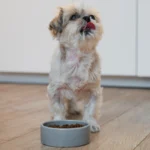

I never considered how fast my dog eats. Put the food in the bowl, it’s gone in 20 seconds, and that’s it. I realized I was ignoring a real health risk when my vet mentioned bloat during a routine check-up. If your dog also eats food at a fast speed, then this article is for you. You must read this article.
At DogFoodsUK, we spend a lot of time writing about which dog food will be right for your dog. But how your dog actually eats that food matters just as much. A slow-feeder dog bowl may seem like a gimmick, but the research and veterinary advice behind it is strong. I’ve spent the last few months testing and researching the best options available to UK dog owners, and this article covers everything I found.
Whether you have a Labrador retriever who treats every meal like a race, a spaniel puppy who eats their puppy food so fast they can barely chew, or a deep-chested breed where bloat is a real concern, there’s a product that will help.
Why fast eating is dangerous for dogs
When a dog eats too quickly, it swallows a lot of air along with the food. This air accumulates in the stomach and causes it to stretch and expand. In most cases, this causes mild discomfort, a little belching, and perhaps some flatulence that clears the entire room.
But in more serious cases, the swollen stomach can twist in place. This is called gastric dilatation volvulus, or GDV. When the stomach twists, blood flow to the organ is cut off, and gas builds up, but there is no way to escape. GDV is a veterinary emergency. Without immediate treatment, a dog with GDV can die within hours.
The British Veterinary Association (BVA) considers GDV one of the most acute and life-threatening conditions in dogs. Surgery is almost always required, and even with prompt treatment, mortality rates range from 15% to 30%. These are not odds you want to risk.
Fast eating also causes digestive problems that are not as dramatic, but are still preventable. Dogs who eat their food too fast often vomit shortly after eating. They also experience gas, bloating, and general stomach discomfort. Over time, poor digestion can affect nutrient absorption, meaning your dog isn’t getting the full benefit of the best dry dog food UK brands you’re paying for.
Which dogs are at higher risk? Deep-chested breeds are obvious. Great Danes, German Shepherds, Standard Poodles, Weimaraners, and Setters have chest shapes that can increase the risk of GDV. But any dog can develop bloat. I’ve spoken to vets who have treated Border Collies, Labradors, and even Jack Russells for GDV. The risk is higher in larger breeds, but not limited to them.
The PDSA lists rapid eating as one of the primary risk factors for bloat, along with exercising immediately after meals and feeding only one large meal a day. Blue Cross offers similar advice and recommends slow feeder bowls as a practical preventative measure.
How Slow-feeder Bowls Actually Work
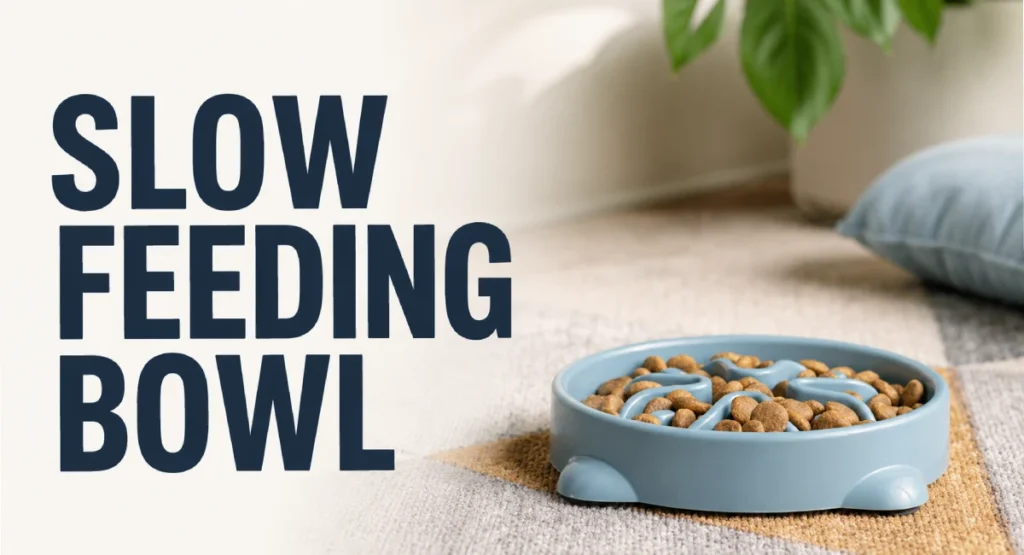
The concept is simple. Slow feeder bowls have built-in obstacles, ridges, or patterns that force your dog to work around them to reach the food. Instead of picking up a mouthful of kibble in one go, the dog has to use its tongue and nose to move around the obstacles and pick up small amounts of food at a time.
This does two things. First, it physically slows down the eating process. A meal that previously took 20 seconds can now take 3 to 5 minutes. Secondly, it reduces the amount of air your dog swallows, as they are eating in smaller mouthfuls and eating more deliberately.
The RSPCA recommends environmental feeding methods that encourage natural foraging behavior, and slow feeders fit perfectly into this category. In the wild, dogs don’t eat from flat bowls. They scavenge, forage, and work for their food. Slow feeders utilize this instinct in a safe and controlled way.
Most slow feeders slow down eating by 3 to 10 times, depending on the design and your dog’s determination. Some dogs understand how to flip a bowl or clear obstacles with their paws. Other dogs simply learn to eat at a reasonable pace around ridges. Effectiveness varies, but even a slight slowing in eating speed can make a meaningful difference to digestion and bloat risk.
Types of slow feeders explained
Not all slow feeders work the same way. There are different types. You should choose the right one based on your dog.
Maze bowls
Maze bowls are the most common type. These bowls have raised ridges, walls, and channels molded into them that create a puzzle pattern. Your dog must move his nose and tongue through the channels to reach the food. The complexity of mazes varies depending on the model. Simple designs have a few straight ridges. Complex designs have spirals, concentric circles, and multiple chambers.
Maze bowls work well for most dogs and are simple to use. You put the food in the bowl, and the ridges do the rest. These are best for kibble and semi-moist food. Wet food can get stuck in narrow channels and be difficult to clean.
Lick mats
Lick mats are flat silicone sheets with textured patterns. You spread soft food on the surface, and your dog eats by licking it. The texture significantly slows down the licking process. Lick mats work well with wet food, yogurt, peanut butter, pate, and mashed pumpkin. They are less effective with standard dry kibble.
Lick mats also have an additional benefit that fun bowls don’t. Repetitive licking action can have a calming effect on dogs. Licking releases endorphins, which can help reduce anxiety and stress. If your dog gets overly excited or restless before meals, a lick mat can help him calm down while eating.
Elevated slow feeders
Elevated feeders raise the bowl above the ground, usually 15 to 30 cm. The idea is that the raised position causes the dog to swallow less air while eating, thus reducing strain on the neck and joints. Some elevated feeders also combine the raised platform with built-in slow feeding barriers.
The evidence on elevated feeders and bloat is actually mixed. Some studies suggest that raised bowls may increase the risk of GDV in large breeds, while others show the opposite. I recommend discussing this with your vet before choosing an elevated feeder for a deep-chested breed. The ergonomic benefits are more clear for smaller dogs and older dogs with mobility issues.
Puzzle and treat-dispensing feeders
Puzzle feeders require the dog to move or handle the feeder to release the food. This could mean pushing a ball with their nose, moving levers with their paws, or rolling a wobbly device across the floor. This is the most interactive type of slow feeder and the most effective at prolonging meal time.
Treat-dispensing feeders, like the KONG Wobbler, fall into this category. You fill the device with kibble, and your dog has to bat, nudge, and roll it to get the pieces out. Some dogs pick these up quickly, while others take days to master the technique. In both cases, a meal that takes 5 minutes from a maze bowl may take 15 to 20 minutes from a puzzle feeder.
Snuffle mats
Snuffle mats are fabric mats made of long fleece strips or fabric folds, where you hide food between them. Your dog sniffs and searches the fabric to find the kibble. These work with a dog’s natural foraging instincts and are excellent for engaging their sense of smell. They are the most natural type of slow feeder.
Snuffle mats aren’t so much about physical obstacles, but rather about mental engagement. Your dog has to use their nose to locate each food piece, which significantly slows down eating. They’re washable, portable, and work with any type of dry food or small treats.
The best slow feeder bowls available in the UK
I’ve tested and researched the six most popular slow feeders currently available in the UK. Each one is suitable for a different type of dog and a different feeding style. Here’s my honest assessment of each product.
Outward Hound Fun Feeder Slow Bowl
Best for: most dogs who eat dry kibble and need a reliable, no-fuss way to slow down at meal times.
The Outward Hound Fun Feeder is perhaps the most well-known slow feeder on the UK market, and the reason for its reputation is genuine. It comes in several fun patterns, from simple designs, like a few concentric rings, to complex designs, like a full spiral with multiple chambers. Its groove pattern is what makes it effective. Your dog has to push their tongue through channels to reach each kibble piece, which naturally slows it down.
It’s made from food-grade PVC that’s free of BPA, PVC, and phthalates. The base has a non-slip ring that keeps it stable on tiled or wooden floors, and this matters more than you might think. My mate’s Labrador would push his old bowl halfway across the kitchen with every meal. Outward Hound stayed in its place.
It’s available in 3 sizes: small, which holds about 200g, medium, roughly 400g, and large, which can hold up to 600g depending on the kibble size. The small size works well for toy and small breeds. The medium and large can handle everything from Cocker Spaniels to Golden Retrievers. If you have Great Dane, choose the large size and consider feeding the food in 2 portions.
The Fun Feeder comes in several colors: green, blue, orange, and purple. Obviously, color doesn’t affect performance, but if you care about kitchen aesthetics, options are available.
Things to consider: Deep grooves can trap kibble dust and residue if you don’t clean it properly. A bottle brush or old toothbrush helps clean corners. The PVC material is durable, but may develop a slight odor over time if not washed properly. Some determined dogs can learn to lift and flip the entire bowl, especially smaller dogs with lighter sizes. If your dog is a bowl-flipper, you may need to place it against a wall or use a heavier mat underneath.
Which dogs it suits: More size dogs from toy breeds to large breeds, dogs eating standard dry kibble, first-time slow feeder users, and owners who want a simple and proven option.
Which dogs may need another option: Dogs on exclusively wet food diets, as it works great with gravy and chunks, dogs with flat faces like Pugs that struggle to reach food in deep channels, and extremely determined dogs who will flip the bowl to bypass the fun.

You can check pricing on Amazon UK where it’s widely available with Prime delivery.
LickiMat Tuff Mat
Best for: For dogs who eat wet food, soft foods, or treats, and for owners who want a dual-purpose feeder that also provides anxiety relief.
The LickiMat Tuff Mat uses a completely different approach to slow feeding. Instead of obstacles inside the bowl, it’s a flat rectangular sheet of food-grade rubber with a crosshatch pattern of raised bumps. You spread soft food on the surface and your dog eats by licking it. The pattern creates hundreds of tiny pockets that hold food, so the dog has to extract food from each pocket individually.
The “Tuff” in the name is due to the material. It’s made of a durable rubber compound that’s tougher than the standard LickiMat Buddy. This matters because some dogs start chewing on the lick mat after the food is gone. The Tuff Mat resists this better than softer versions, though no mat is truly indestructible against a determined chewer.
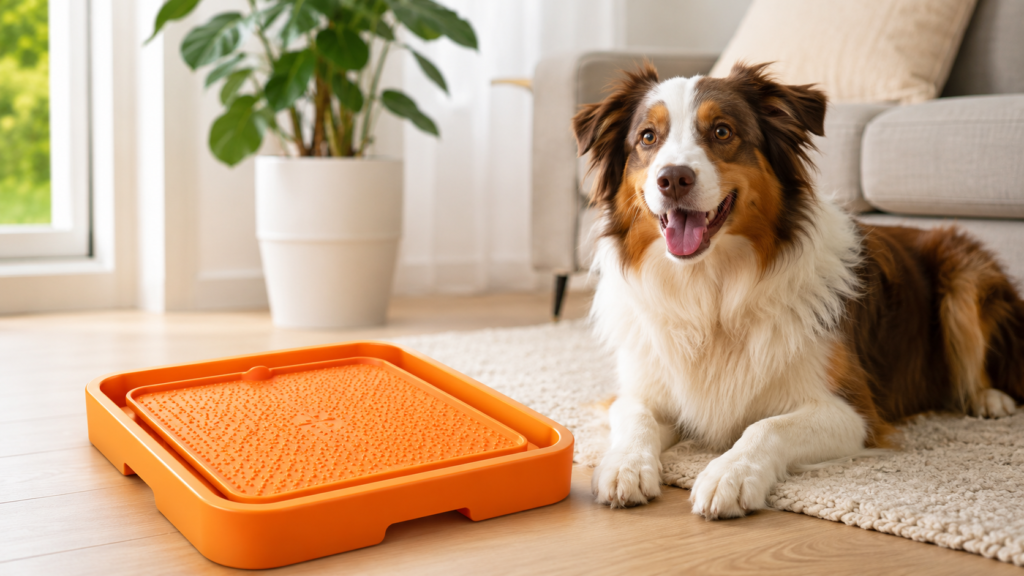
What you put on it depends on you. Wet dog food, mashed banana, plain yogurt, xylitol-free peanut butter, soaked kibble, pate, even raw mince. The advantage of the spreadable consistency is that you can mix the medications into the food and the dog will lick it without notice. If your dog has a habit of spitting out tablets, this is a practical workaround.
The calming effect is the real benefit. Repetitive licking action releases endorphins in your dog’s brain, which have a soothing effect. FEDIAF guidelines note that environmental enrichment during feeding supports dogs’ positive mental well-being. The LickiMat is the easiest way to provide this enrichment.
Things to consider: It doesn’t work with standard dry kibble. You need to use it with spreadable or soft food. The mat needs to be cleaned after each use, and the crosshatch pattern can trap food residue in the grooves. A quick rinse under the tap is usually sufficient, but a proper wash with warm soapy water every few days keeps it hygienic. It’s dishwasher safe on the top rack, which is handy. The mat doesn’t have suction cups, so determined dogs may be able to lift it in and out. Placing it on a non-slip mat or holding it in your hand for the first few uses helps establish the right behavior.
Which dogs it suits: Dogs on wet food or raw diets, anxious dogs who benefit from calming enrichment, dogs who need to hide medication in their food, flat-faced breeds who struggle with deep maze bowls, and puppies who are transitioning to solid food.
Which dogs may need another option: Dogs on exclusively dry kibble diets, heavy chewers who will destroy mats, and owners who want a simple bowl-based solution that can be filled and set to the side.
Neater Feeder Express
Best for: messy eaters who scatter food everywhere, and owners who want a combined elevated feeder with spill protection.
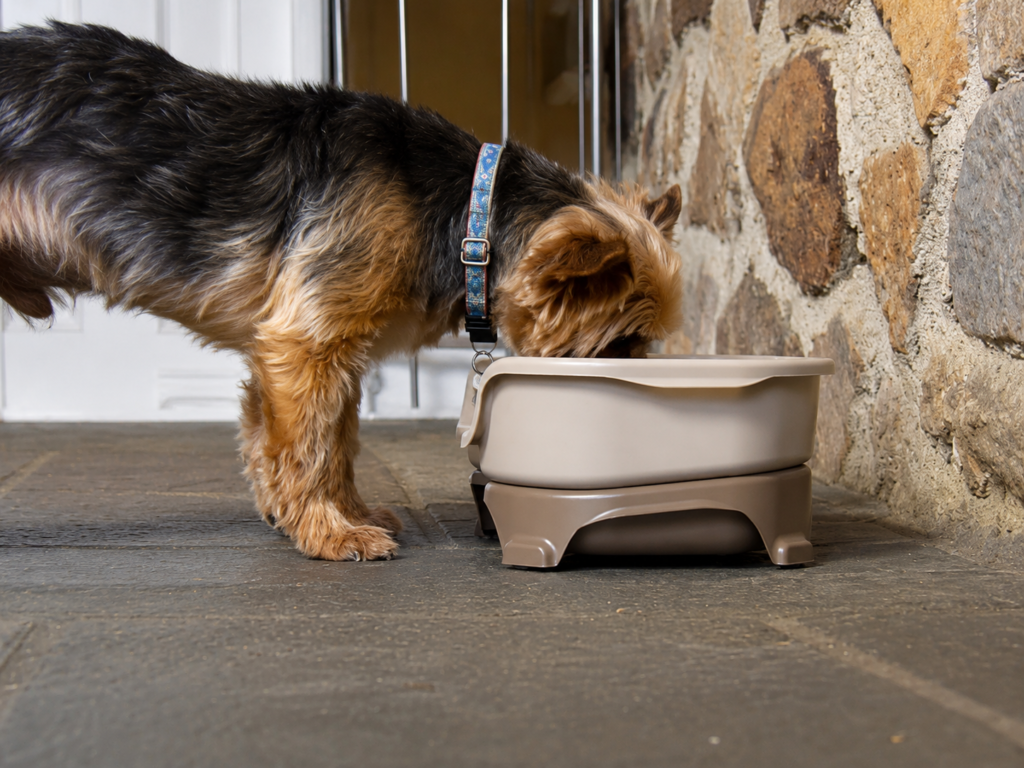
The Neater Feeder Express is an elevated feeding system with a unique design. It features double-wall construction, where the outer walls catch food that gets pushed or spilled from the inner bowl. Food is directed back into the lower tray instead of falling to the floor. Water spills are directed into a separate reservoir area. If your dog tends to get kibble into places where kibble is useless, this system genuinely solves that problem.
The elevated design raises the eating position roughly 8cm, which is a moderate height for small to medium dogs. This reduces neck strain during eating, which is especially useful for older dogs with arthritis or neck and spine issues. The bowls themselves are standard stainless steel, which is the most hygienic material for dog bowls.
Now, the Neater Feeder Express bowl does not have built-in slow feeding obstacles. You can pair it with any slow feeder bowl that fits in the holder, or use the included standard bowl. The slow feeding effect comes from the elevated position and smaller bowl size rather than the maze ridges. For the full slow feeding benefit, you will need to swap out the maze bowls or combine this system with a separate slow feeder.
It is available in several sizes and colors. The Small size works for dogs up to about 15 kg. The Medium handles dogs up to 30 kg. The Large is for bigger breeds. Before purchasing, measure your dog’s shoulder height and compare it with the feeder measurements to ensure the height is appropriate.
Things to consider: This is a feeding system, not a purely slow feeder. If your main concern is slowing down eating speed, a fun bowl like the Outward Hound is more effective on its own. The Neater Feeder Express works best as a complete feeding station, where you can also incorporate slow feeding. It is also bulky. Takes up more floor space than a standard bowl, and the two-piece design means more parts to clean. The spill-catching tray needs to be emptied regularly, especially if your dog is a very enthusiastic eater.
Which dogs it suits: Messy eaters, small to medium dogs who benefit from elevated feeding, older dogs with mobility issues, multi-dog households where one dog pushes food out of its bowl, and owners who prioritize clean floors.
Which dogs may need another option: Owners whose sole priority is slowing down eating speed, large deep-chested breeds where elevated height is not appropriate, and those with limited kitchen floor space.
KONG Wobbler
Best for: Active and intelligent dogs who need mental stimulation along with slow feeding, and for owners who want to slow down the eating speed as much as possible.
The KONG Wobbler is a treat-dispensing toy that also works very effectively as a slow feeder. It’s a hollow, dome-shaped container with a weighted bottom and a small opening at the top. You fill it with kibble, and your dog has to nudge, push, and bat it to get the kibble pieces out, one piece at a time.
This Product is Popular in the USA: KONG Wobbler USA
The weighted bottom allows it to wobble and straighten itself, but not tip over completely. Whenever your dog pushes on it, some kibble pieces fall out of the dispensing hole. A meal that would finish in 20 seconds with a normal bowl can take 15 to 25 minutes with a Wobbler. This is a serious slowdown, and the most effective option on this list for extremely fast eaters.
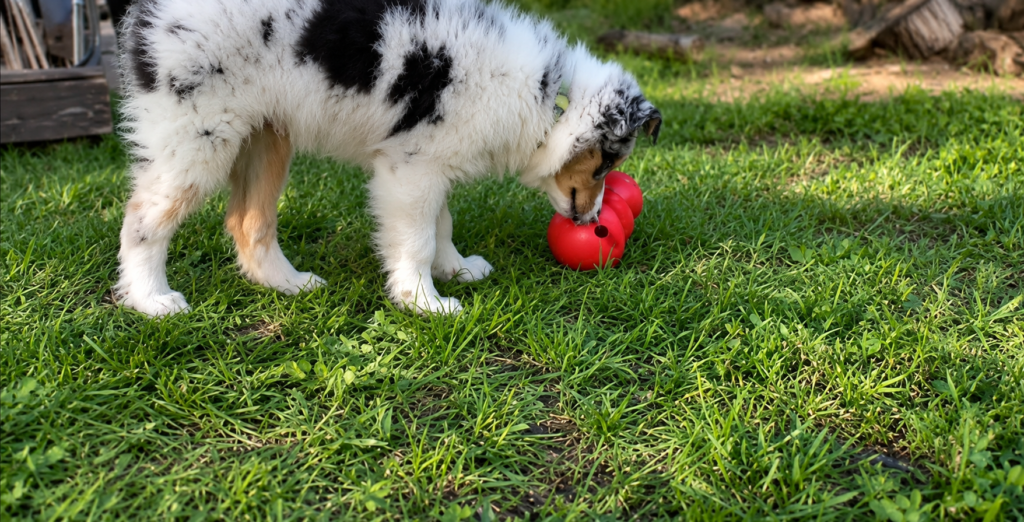
KONG is one of the most trusted names in dog products. The rubber compound they use is almost indestructible to most dogs. I’ve seen Labs, Staffies, and even Malinois fail to bite on KONG products. The Wobbler uses the same material. If your dog has destroyed other slow feeders, the Wobbler is worth a try.
It comes in two sizes: small, which holds about 80g of kibble, and large, which can hold up to 250g. The large size is more suitable for medium to large dogs. The small toy works for smaller breeds. There’s also a Wobbler version for cats, which is even smaller. Be sure to buy the right size, as the dispensing hole is proportional to the size of the toy. If a large dog tries to get food out of a small Wobbler, they may become frustrated.
Things to consider: The Wobbler is loud on hard floors. The weighted base makes a noticeable thunking sound when the dog pushes it, which may not be ideal if you work from home or have downstairs neighbors. Carpet reduces noise, but friction can make it harder for small dogs to move. The dispensing hole can be adjusted by turning the top, so you can make it easy or hard. However, on the hardest setting, some kibble shapes may not fall out at all. Test with your specific food to find the right setting.
This only works with dry kibble or firm treats. Wet food will clog the dispensing hole and make a huge mess. This is a dry food-only tool. Some dogs even figure out that they can hold the wobbler with their paw and lick the kibble directly from the opening. Smart dogs will mess up everything. If your dog does this, increase the difficulty setting or use a slightly larger kibble.
Which dogs it suits: Highly food-motivated dogs, intelligent breeds that enjoy problem-solving, dogs that have destroyed other slow feeders, fast eaters that need maximum slowdown, and active dogs that benefit from working for their food.
Which dogs may need another option: Dogs that only eat wet food, dogs that get frustrated and give up quickly, very small or toy breeds that struggle to push larger versions, and owners who need a quiet feeding solution for shared living spaces.
Leashboss Maze Bowl
Best for: Owners who prefer stainless steel over plastic for hygiene and durability reasons, and for dogs with sensitivities to plastic materials.
Most slow feeder bowls on the market are made of plastic or rubber. The Leashboss Maze Bowl stands out because it’s made of stainless steel and has welded slow feeding pillars. If you’re wary of plastic food bowls, and there are genuine reasons for that, such as concerns about bacterial buildup and chemical leaching from scratched surfaces, stainless steel is the safest material.
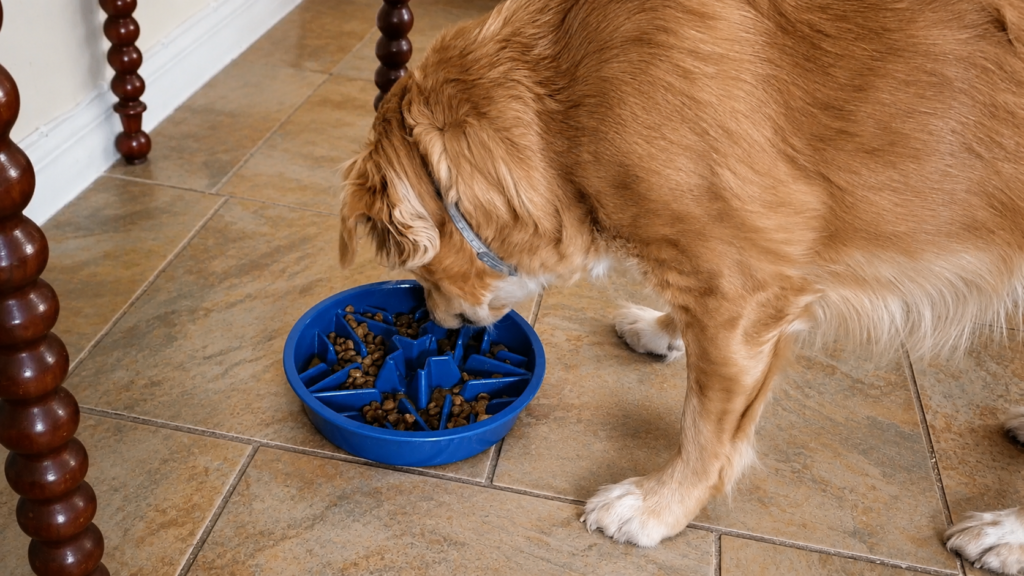
Stainless steel construction makes it extremely durable. It won’t crack, warp, develop scratches where bacteria can hide, and won’t absorb food odors over time. You can scrub it with a brush, put it in the dishwasher, and even after 5 years, it will still look almost like day one. This is a strong choice for owners who want a long-lasting option.
Its internal pillars are arranged in a fun pattern that forces the dog to push the food around them, slowing down eating. The design isn’t as complex as the Outward Hound Fun Feeder, so it provides a moderate slowdown instead of an extreme slowdown. If your dog needs a gentle introduction to slow feeding, the simple pattern is actually an advantage. It’s frustrating enough to slow the dog down, but not so complicated that they give up.
The base has a rubberized non-slip ring that provides good grip on smooth floors. The bowl is available in 1 size, which holds roughly 400g of standard kibble, making it suitable for small to medium dogs. Larger breeds may need a larger capacity, and the Leashboss is not currently available in an XL size.
Things to consider: Stainless steel conducts heat well. If you place the bowl in a cold room or near a door in winter, the metal can become cold. Most dogs won’t have an issue with this, but some sensitive dogs may hesitate. The single size limits it to very large or very small breeds. The maze pattern inside the bowl is fixed, so you can’t adjust the difficulty level. Some dogs quickly grasp the pattern and can start fast eating again after a few weeks. Welded pillars create internal corners that are harder to clean than Outward Hound’s open channels. A bottle brush is a must.
Which dogs it suits: Owners who prefer stainless steel, dogs with plastic allergies or sensitivities, dogs who need a gentle introduction to slow feeding, small to medium breeds, and any owner who wants maximum hygiene and longevity in a dog bowl.
Which dogs may need another option: Very large breeds who need a bigger bowl capacity, dogs who need an extreme eating slowdown, and owners who want adjustable difficulty levels.
Snuffle Mat for Dogs
Best for: Dogs who love to use their noses, anxious dogs who need calming enrichment, and owners who want the most natural slow feeding option.
A Snuffle Mat is a fabric feeding tool, not a bowl. It’s made of fleece or fabric strips sewn onto a rubber base, creating a dense area of fabric folds and pockets. You sprinkle dry kibble or small treats inside the fabric, and your dog sniffs and searches through the material to find each piece. This directly utilizes the dog’s natural foraging behavior. In the wild, dogs spend a significant portion of their day using their noses to locate food. A Snuffle mat recreates that experience in your living room.
Mental engagement is remarkable. Watching a dog work on a Snuffle mat is genuinely fascinating. First, it makes broad sweeps with its nose, then focuses on specific areas after catching a scent. Usually, its tail is wagging the entire time. This is one of the few feeding methods that makes dogs feel not just fed, but genuinely happy.
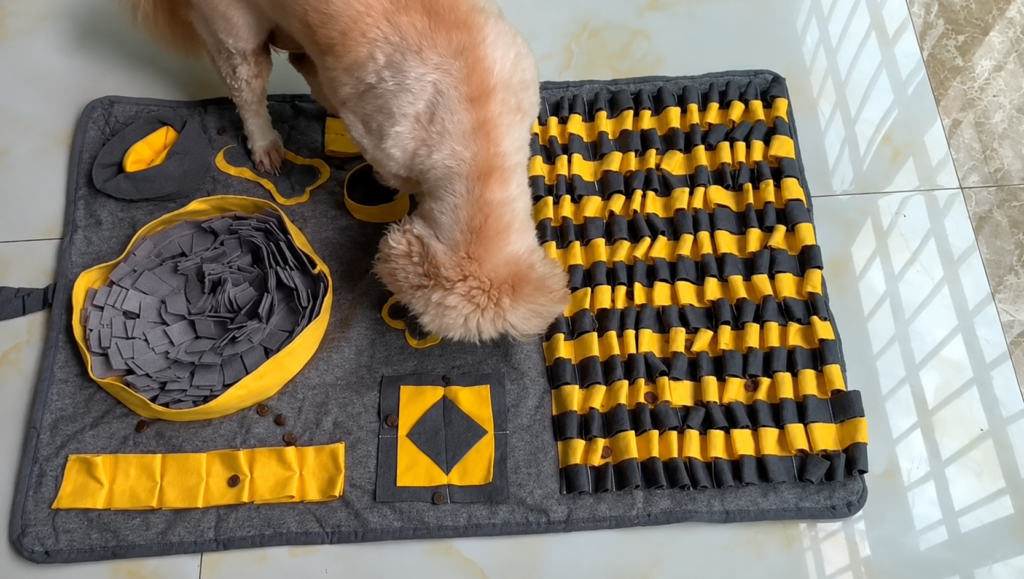
Snuffle mats are extremely effective at slowing eating. 200g of food scattered across a large Snuffle mat can easily take 10 to 20 minutes. Because the dog isn’t just eating, they’re hunting. Each piece of kibble is a small victory. The process is inherently slow, as the dog has to locate each piece by scent before eating it.
They are portable, lightweight, and easy to store. You can roll them up and take them to the park, on holiday, or to a friend’s house. They work on any flat surface. Most are machine washable, though you should check specific care instructions, as some mats use glue that can break down in hot washes.
Things to consider: Snuffle mats only work with dry kibble, small treats, or dry food toppers. Wet food soaks into the fabric and creates a hygiene nightmare. They need to be washed regularly. Food crumbs, saliva, and general grime build up in the fleece over time. Once a week is the minimum. If your dog is a heavy drooler, washing may be necessary every few days. Some dogs learn to pick up the entire mat and shake it so that all the food falls out at once. This defeats the purpose. If your dog does this, hold the mat with your hands for the first few sessions and reward calm foraging behavior.
Snuffle mats are not chew toys. Some dogs may rip and eat the fleece strips, which is a serious choking hazard. If your dog is a destructive chewer, closely supervise use with a snuffle mat or choose a different type of slow feeder. Fabric wears out over time. With regular use, depending on the quality, a snuffle mat may need to be replaced every 6 to 12 months.
Which dogs it suits: Dogs with strong foraging instincts, especially scent hounds and working breeds, anxious dogs who benefit from calming nose work, dogs who get bored easily, flat-faced breeds that cannot access deep maze channels, and owners who want to add mental stimulation to mealtimes.
Which dogs may need another option: Dogs on wet food diets, destructive chewers who will destroy fabric, dogs who learn to shake food out, and owners who want a low-maintenance feeding solution.
How to choose the right slow feeder for your dog
Choosing the right slow feeder depends on a few practical factors. Follow these questions, and the right choice will often become clear.
What does your dog eat?
Dry kibble works with every type of slow feeder on this list. Wet food limits your options to lick mats, snuffle mats, small dry toppers only, and the stainless steel bowl of a Neater Feeder. If your dog eats a mixture of wet and dry food, the LickiMat Tuff Mat is perhaps the most versatile option, as you can spread both textures on it. Check our dog food ingredients guide to choose the right food for your dog’s needs.
How fast does your dog actually eat?
There’s a difference between a dog that finishes a meal in 45 seconds and a dog that finishes a meal in 10 seconds. If your dog finishes in less than 30 seconds, you need a more robust solution. A complex maze bowl like the KONG Wobbler or Outward Hound will provide the most slowdown. If your dog eats in about 1 minute and you just want to slow him down a bit to a healthier pace, a simpler maze like the Leashboss or a lick mat may suffice.
What size is your dog?
Match the bowl capacity to your dog’s portion size. If a Chihuahua eats 50g of kibble, they’ll need a smaller bowl. If a Labrador eats 300g, they’ll need a larger bowl. Check the product’s stated capacity and compare it to your dog’s usual portion. If the bowl is too small, you’ll have to refill it between meals, defeating the purpose. If the bowl is too large, the food will spread too much, making the barriers less effective.
Does your dog have any physical limitations?
Flat-faced breeds like Pugs, French Bulldogs, and Shih Tzus struggle with deep maze channels. Their muzzles are short, so they can’t easily reach food in narrow gaps. For brachycephalic breeds, a LickiMat or snuffle mat works better because they can easily access food from a flat surface. Older dogs with arthritis or dental issues may also prefer shallow feeding options.
How determined is your dog?
Some dogs tolerate slow feeders and gradually adjust. Other dogs flip the bowl, chew obstacles, or find creative ways to bypass the entire system. If your dog is a determined problem-solver, choose a tough option. The KONG Wobbler and Leashboss Maze Bowl are the most destruction-resistant options. Snuffle mats are the most vulnerable to creative dogs, as some dogs quickly figure out how to empty it quickly.
How to introduce a slow feeder to your dog
Don’t expect everything to happen smoothly just by placing the slow feeder in front of your dog at dinnertime. Gradual introduction works much better and reduces the chances of frustration, anxiety, or food refusal.
Initially, place the slow feeder on an empty floor during a calm moment. Let your dog sniff it, investigate it, and become comfortable with this new object. Some dogs are suspicious of unfamiliar feeding equipment. Give them time to accept it before adding food.
Next, put a small amount of food in the slow feeder, maybe a quarter of a normal portion. Use a high-value food, such as their favorite kibble mixed with some treats. The goal is to make the slow feeder feel more rewarding than their normal bowl, not less. Let them learn at their own pace how to get the food out. Don’t rush them or make them overeat anxiously.
Over the next few meals, gradually increase the amount of food in the slow feeder and decrease the amount in the normal bowl. Within 1 week, most dogs will start eating their full portion from the slow feeder. Some dogs adapt within 1 meal. Others may take a few weeks. Both responses are normal.
If your dog shows signs of frustration, such as aggressively pawing the bowl, whining, or refusing food by walking away, simplify the challenge. Use a less complex maze pattern or reduce the obstacles. You can later increase the difficulty once the dog is comfortable with the concept. The goal is slower eating, not mealtime misery.
Cleaning and maintaining your slow feeder
Hygiene matters. Any feeding surface that leaves food residue can harbor bacteria over time, and slow feeders have more crevices and surfaces than standard bowls. Here’s how to keep them clean.
Wash out play bowls like Outward Hound’s with warm water and dish soap after every meal. Deep grooves require a brush to clean properly. An old toothbrush or bottle brush will work for reaching into corners. Dishwasher cleaning works for more rigid plastic play bowls, but check manufacturer guidelines first. Dishwashers don’t always reach tight corners, so a manual scrub every few days is still helpful.
Rinse the LickiMat Tuff Mat under warm water immediately after each use. Rubber surfaces don’t hold food as stubbornly as plastic, so a quick rinse is usually sufficient. For a deep clean, use warm soapy water and scrub thoroughly in a crosshatch pattern. It’s top-rack dishwasher safe, which is convenient. Do not use bleach or harsh chemicals on any rubber feeding product. These can damage the material and leave a residue that is unsafe for your dog.
The KONG Wobbler is simple. Unscrew the top, wash both halves with warm soapy water, and rinse thoroughly. The wide opening makes it easy to clean inside. No special brushes are required. It’s dishwasher safe on the top rack.
For stainless steel options like the Leashboss, a standard wash with warm soapy water is sufficient. Stainless steel is naturally resistant to bacterial growth, which is one of its main advantages. To maintain the surface finish, polish it occasionally with a soft cloth.
Snuffle mats require the most maintenance. Shake out loose crumbs after each use. Machine or hand wash once a week on the gentle cycle. Be sure to check the care label. Some snuffle mats handle a 30-degree wash, but some require hand washing only. Air dry completely before using again. If a damp snuffle mat is stored wet, mold can develop in the fleece folds.
Are slow feeders safe for puppies?
Yes, puppies can use slow feeders, provided a few important things are kept in mind. Slow feeders are absolutely possible for puppies, and it’s a good idea to introduce them at an early age. Puppies that learn to eat at a reasonable pace from the start are less likely to develop fast-eating habits as they mature.
Choose a slow feeder based on your puppy’s size and physical ability. A large maze bowl designed for a Labrador may be too big and complex for a 3-month-old Cocker Spaniel puppy. For very young puppies, the LickiMat Tuff Mat is often the best option, as the flat surface is easy to access and the soft food texture is suitable for their developing teeth and jaws.
Supervise your puppy with any new feeding device for the first few uses. Puppies may try to chew the feeder or eat the food more than adult dogs. The rubber of the LickiMat is tough, and the rubber of the KONG Wobbler is almost indestructible, but no material is completely chew-proof if a teething puppy is very determined.
Puppies need more frequent meals than adult dogs. Most puppies are best on 3 to 4 meals a day until they are 6 months old. While a slow feeder takes 10 minutes per meal for an adult dog, that’s fine, but using it for a puppy’s 4 daily meals can mean 40 minutes of feeding time. This is quite a lot of time for a young puppy. When the puppy is young, you can use the slow feeder for 1 or 2 meals and use a standard bowl for the remaining meals.
If you’re deciding what to feed with a slow feeder, our puppy food guide covers the best options for growing dogs in the UK.
Where to buy slow feeders in the UK
Amazon UK is the most convenient option for buying slow feeders. You can find fast delivery, easy returns, and a wide selection. Search for slow feeder dog bowls on Amazon UK and you’ll find dozens of alternatives, along with the products mentioned in this guide. Be sure to check buyer reviews, especially those with photos, to get an honest idea of what you’re buying.
Pets at Home stocks a limited range of slow feeders in its physical stores and online shop. The advantage of buying in person is that you can see the size and feel the material before purchasing. The disadvantage is that the selection is smaller compared to online. These usually carry Outward Hound and some own-brand options.
Buying direct from the manufacturer can sometimes be cheaper, especially for brands like LickiMat and KONG, which run promotions on their websites. If you’re in a hurry, you can sign up for their newsletters. KONG products are also widely available at UK pet retailers.
Specialist online pet retailers like VetUK, Monster Pet Supplies, and Zooplus carry a good range of slow feeders, with UK customer support and proper returns policies. Their prices are often competitive with Amazon’s, and sometimes even better during sale periods.
Wherever you buy from, be sure to check the returns policy. If your dog refuses to use a slow feeder, it’s useless, no matter how good the design. The 30-day return window gives you time to test whether your dog will actually eat from it. Some dogs accept slow feeders immediately. Others need a longer adjustment period. Having the option to return and try different types is very useful.
Final thoughts
After testing these products and talking to UK vets and dog owners, my top pick for most dogs is the Outward Hound Fun Feeder Slow Bowl. It’s affordable, effective, available in multiple sizes and complexity levels, and most dogs accept it without much fuss. If any UK dog owner is dealing with a fast eater, this is the slow feeder I’d recommend first.
For wet food-eating dogs, the LickiMat Tuff Mat is the clear winner. It’s practical, calming, and works with food textures that fun bowls can’t handle. For the most determined fast eaters, the KONG Wobbler provides the greatest eating slowdown and is virtually indestructible.
If you’re switching to a slow feeder to reduce bloat risk, remember this is just one part of a broader approach. The BVA recommends feeding your dog two or three smaller meals a day instead of one large meal, avoiding exercise at least an hour before and after meals, and not letting your dog drink too much water immediately after meals. Slow feeders help with the eating speed part, but these other factors also matter.
Whichever slow feeder you choose, pair it with quality food. Slow feeding poor-quality food won’t make it any better. If you’re unsure if you’re feeding the right food, check out our best dry dog food UK guide. Combining a good slow feeder and nutritious, suitable food is one of the simplest steps to protecting your dog’s digestion and reducing the risk of serious conditions like GDV.
Your dog’s health is more important than the cost of the feeding bowl. Make the change, be patient during the transition, and for once, enjoy your dog actually tasting the food, instead of watching it inhale like competition.
Frequently asked questions
How much slower will my dog eat with a slow feeder bowl?
It depends on the type of slow feeder and your dog. Maze bowls typically slow eating by 3 to 5 times. A dog that finishes a meal in 30 seconds with a normal bowl may take 90 seconds to 2.5 minutes with a maze bowl. Puzzle feeders like the KONG Wobbler can extend meal time to 15 to 25 minutes. Lick mats and snuffle mats fall in between, usually adding 5 to 10 minutes to the meal. Every dog is different. Some dogs understand obstacles quickly and then speed up over time. Other dogs remain slow eaters long-term with a feeder.
Can slow feeders completely prevent bloat?
No. Slow feeders reduce one risk factor for bloat, which is rapid eating. But bloat has multiple causes and risk factors, including breed genetics, chest shape, feeding one large meal a day, exercising after meals, and stress. Slow feeding is a preventative measure, not a guarantee.
If you have a deep-chested breed like a Great Dane, Weimaraner, or Standard Poodle, discuss bloat prevention with your vet. They can advise on feeding schedules, portion sizes, and in some cases, a preventative surgical procedure called gastropexy.
Will my dog get frustrated and stop eating?
Some dogs may become frustrated initially, especially with complex maze bowls or puzzle feeders. This is usually temporary. Start with a simple design and easy difficulty setting, then gradually increase the challenge.
If your dog walks away from the slow feeder and refuses to eat, don’t force it. Return to their normal bowl and then try a less challenging option. The goal is to make mealtimes slow, not stressful. Most dogs adjust within a few days to 2 weeks.
Are plastic slow feeder bowls safe?
Food-grade plastics that are BPA-free and phthalate-free are considered safe for dog bowls. For example, the Outward Hound Fun Feeder is made from food-safe PVC. But plastic develops scratches over time, and bacteria can hide in those scratches.
Stainless steel options like the Leashboss Maze Bowl are more hygienic in the long run because their surface doesn’t scratch as easily. If you choose a plastic bowl, inspect it regularly for deep scratches and replace the bowl when the surface becomes worn.
Can I use a slow feeder with raw food?
This depends on the type of raw food. Small pieces of raw mince may work in lick mats and shallow maze bowls. Larger raw meat chunks or bones will not work in any slow feeder.
Snuffle mats are not suitable for raw food because meat juices soak into the fabric and are then very difficult to clean properly. If your dog eats a raw diet and you want to slow down his eating, a stainless steel bowl with simple obstacles is the best option. Wash it thoroughly with hot soapy water after each use to avoid bacterial contamination.
My dog just flips the slow feeder bowl over. What should I do?
This is common, especially with lighter dogs and smaller bowl sizes. Place the bowl against a wall or in a corner to prevent it from tipping over. Place a non-slip mat underneath for extra grip. Some owners use a heavy ceramic bowl weight on top to prevent the slow feeder from tipping over.
If this still doesn’t solve the problem, switch to a slow feeder that doesn’t tip over, such as a snuffle mat or a heavy rubber puzzle feeder like a KONG Wobbler. Wobblers are specifically designed to resist tipping.
How do I know which difficulty level to choose?
Start easy. If your dog has never used a slow feeder before, choose the simplest design. The LickiMat Tuff Mat is one of the easiest options, as the food is kept on the surface. A simple maze bowl with a few straight ridges can be a good next step.
Move on to complex spiral or puzzle feeders once your dog is comfortable with the basic concept. You can always increase the difficulty later, but offering too many difficult options at first can turn your dog off completely. Watch your dog’s body language. Relaxed eating with occasional pauses is a good sign. Frustrated pawing, whining, or walking away means the difficulty is too high.
How long do slow feeder bowls last?
Stainless steel bowls like the Leashboss Maze Bowl can last for years, possibly even your dog’s lifetime. Rubber products like the KONG Wobbler and LickiMat Tuff Mat are also extremely durable and typically last 2 to 5 years with regular use.
Plastic maze bowls like the Outward Hound last 1 to 3 years, after which the material begins to show wear, scratches, and absorb odors. Snuffle mats have the shortest lifespan, roughly 6 to 12 months, as the fabric thins and stitching can loosen with regular washing.
Replace any feeders that develop cracks, deep scratches, or loose parts, as these can become a choking hazard.
Can slow feeders help with dog obesity?
Indirectly, yes. Slow feeders make meal times longer, giving your dog’s brain more time to register that it is full. Dogs who eat too quickly often overeat, before their bodies signal that they have had enough.
Slower eating gives satiety signals time to activate during the meal, not after. Slow feeders may also prevent scavenging behavior after meals. A dog that finishes its meal in 20 seconds and still feels hungry is more likely to beg for treats or steal food. A dog that works at food for 10 minutes with a slow feeder is usually satisfied and less likely to scavenge extra food.
Still, portion control matters more than eating speed for weight management. If you’re overfeeding your dog from the start, a slow feeder won’t help.