
Many people search online for healthy puppy foods. The most popular and health-related topic is grain-free food for puppies. And many people wonder whether grain-free foods are right for dogs or not.
Dogs of all sizes, shapes and ages are given different diets so that they remain healthy and strong. This is also important for puppies because they need a lot of growth in the 12 to 18 months.
For example, puppies need more protein for their growing muscles. However, if the balance of protein and other nutrients is not right, their growth and development can be adversely affected. Earlier, owners had only two options, either give the puppy wet food or dry food.
Now, another option is also being considered, which is grain-free dog food. It is also true that since humans have started demanding grain-free and gluten-free things in their diet, this trend has become popular for dogs as well. However, for some puppies, grain-free foods can still be the right choice. Many dog lovers believe that it is healthier. Some people feed their dogs dry food. It’s understandable to want to add variety to the diet so that your dog doesn’t get bored, because many dogs are moody eaters and need to be given something new.
This guide will tell you everything about grain-free puppy food in a simple way. What it is, how it works, when it’s useful, when it’s not, and how you can choose the right option for your puppy.
I am not a veterinarian. This article is for informational purposes only. Always consult a vet before changing your pet’s diet.
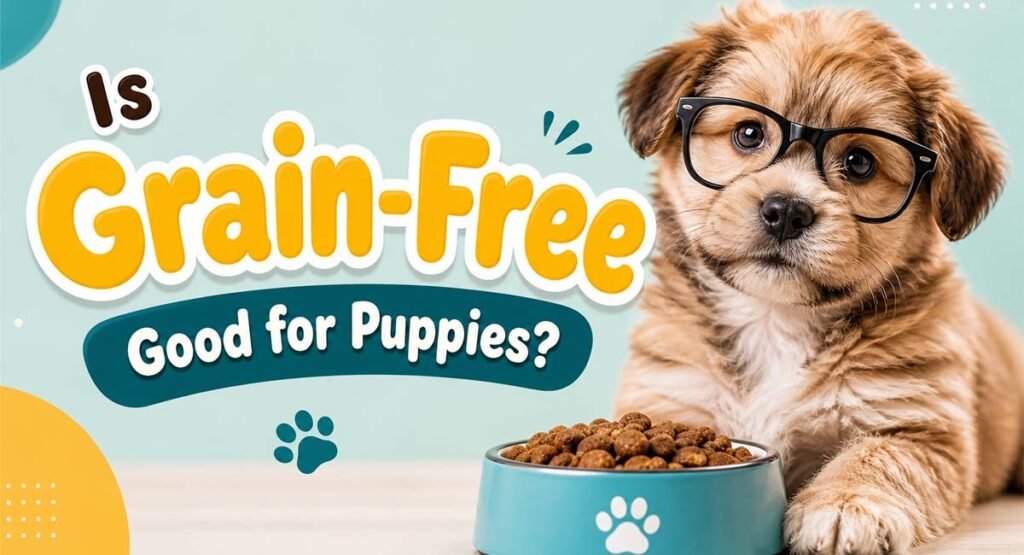
Is Grain-Free Food Good for Puppies?
Grain-free dog food is generally safe for puppies, but it is not automatically better than a diet that includes grains. Grain-inclusive diets are often easier to digest and are also quite affordable. Grain-free is only necessary when the vet has properly diagnosed that the puppy has a grain allergy or intolerance.
Yes, it is safe, but some grain-free formulas have also been linked to heart issues, so don’t follow them blindly. It is always important to choose a high-quality and balanced food, most importantly, after consulting a vet.
Who Is This Article For?
If you are reading this article, you may be a new puppy owner in the UK who wants to do the best for your dog. Maybe your puppy is scratching a lot or has an upset stomach, or you just want to ensure that you are giving him the best possible food. Owners only consider switching to grain-free dog food when their dogs have a problem or want to give them the best. Maybe you:
- A first-time puppy owner overwhelmed by all the dog food options
- A worried puppy parent whose pup has itchy skin, diarrhoea, or a sensitive tummy
- Someone who already feeds grain-free food and wants to know if it’s actually safe
- A large breed or small breed puppy owner looking for the right formula
- A budget-conscious pet parent comparing grain-free vs regular puppy food costs
What Is Grain-Free Puppy Dog Food?
If a dog food says “grain-free,” it means that no grains have been used in it. This includes grains that contain gluten, such as wheat spelt, durum bulgur, wheat barley, rye, and oats. It also means that gluten-free grains, such as corn, millet, rice, and sorghum, are not included. Grain-free diets were originally introduced to treat food allergies in pets, but by the mid-2000s, they became quite popular and were marketed as natural and ancestral. According to PetMD, these diets have passed AAFCO safety testing and have been being fed to dogs for quite some time.
What Replaces Grains in Grain-Free Dog Food?
This is the most misunderstood thing about grain-free dog food. Removing the grains doesn’t necessarily mean the food is low-carb. Puppies still need carbs for energy, which is why manufacturers use these things in place of the grains.
- Sweet potatoes
- Peas and lentils
- Chickpeas
- Tapioca
- White or regular potatoes
These ingredients are perfectly fine for most dogs, but importantly, a 2025 study published in PubMed found that some specific substitutes, especially peas and lentils, may be linked to heart problems in dogs if given in large amounts. We’ll talk about that in a moment.
Grain-Free vs Gluten-Free: They Are Not the Same
Many people think that grain-free and gluten-free are the same thing, but this is completely wrong. There are significant differences between them. In this section, we will explain in detail the real difference between grain-free and gluten-free.
Grain-free puppy food removes all the grains, meaning no wheat, rice, corn, barley, or oats. Because puppies still need carbohydrates for energy, grain-free foods use alternatives instead of grains, such as sweet potatoes, peas, lentils, or chickpeas. Many pet owners choose grain-free food thinking that it is more natural and is suitable for their dog’s ancestral diet. This is true to some extent, but it does not mean that it is automatically healthier. Grain-free only means that the source of carbs has changed, not that the food has become better overall.
Gluten-free puppy food, in contrast, only removes the gluten found in wheat, barley, and rye. Rice and corn are naturally gluten-free, so they can still be included in gluten-free recipes. This is why gluten-free options are less restrictive than grain-free. If a puppy has wheat sensitivity, he doesn’t necessarily need a full grain-free diet. Gluten-free formulas often solve the problem, and that too in a much cheaper option.
Grain-free vs. gluten-free: What is best for puppies
Most healthy puppies in the UK don’t need either grain-free puppy food or gluten-free puppy food. If your puppy seems to be constantly sick, has frequent air infections, or has digestive issues that aren’t getting better with normal food, then consult your vet.
If the problem turns out to be wheat or gluten sensitivity, then gluten-free puppy food is often the best and most affordable solution, and if the vet feels that If the issue is more of a intolerance to large grains, then grain-free puppy food can be tried, but ensure that it contains named animal protein as the first ingredient, has taurine added, and is AAFCO or FEDIAF certified. You can find dog food for large-breed puppies at your nearest pet store. Always choose a formula that is clearly labeled for large-breed puppies, whether it is grain-free or gluten-free.
The Real Benefits of Grain-Free Puppy Food
Grain-free puppy food isn’t just hype; it really makes a difference to your doggie’s health.
Dogs don’t always need grain-free food, but in some cases, they may have health conditions that make it necessary. Some potential benefits of grain-free Puppy Food are listed below.
1. Helps Puppies with Food Sensitivities
Some puppies have issues with grain intolerance. If your puppy is constantly feeling itchy, chews his paws repeatedly, gets frequent ear infections, or has digestive problems even after eating standard food, switching to a grain-free or wheat-free puppy food may help.
According to James Wellbeloved, a respected UK pet food brand, these signs are often of food intolerance and should not be ignored. In such situations, it is best to first understand the cause and then adjust the diet accordingly.
2. Higher Protein Content
Many grain-free puppy foods have high protein levels, which can help grow puppies. Some research suggests that diets with higher animal protein may support digestibility, especially when the formula is properly balanced. Puppies need roughly 22 to 32 percent crude protein in their diet to support growth, and many grain-free puppy formulas meet this requirement well.
3. Easier on Sensitive Stomachs
For puppies whose digestion is generally sensitive, removing grains can sometimes reduce bloating, gas, and loose stools. Products like Taste of the Wild Puppy use sweet potatoes for carbs, which are easier on a puppy’s developing digestive system. Dog Food Advisor also rates this formula highly for digestive comfort.
4. Better Blood Sugar Regulation
A 2025 science review from China Agricultural University found that grain-free diets may support better blood sugar control because their formulations are often based on legumes or tubers rather than high-fat chemical grains. This can be important for some specific health conditions.

Grain-free puppy food is readily available these days both in local markets and on Amazon UK. Along with complete and balanced full-formula options, there are also different formulas for different life stages, breed sizes, and specific puppy needs.
The Risk You Need to Know: Grain-Free Food and Heart Disease (DCM)
This is the reason why I am writing this article on whether grain-free dog food is safe for puppies or not. Many people fall prey to misinformation. If you don’t have the information, it’s fine, but if you have incomplete information, it’s even more dangerous.
In 2018, the US Food and Drug Administration started an investigation because there was a sudden increase in cases of a heart problem in dogs called canine dilated cardiomyopathy. In this condition, the heart muscle becomes large and weak.

Surprisingly, it also affected breeds that normally don’t have it, such as the Golden Retriever and Labrador Retriever. Now, what was the link? According to reports, more than 90 percent of the foods being used in DCM cases were grain-free, and according to data from the American Kennel Club, 93% of these foods contained grains or Lentils were the major ingredient being used.
Does grain-free dog food cause heart problems?
Whenever we talk about grain-free dog food, one thing comes to mind. It is the FDA report that people use to argue that grain-free food causes DCM. But this is not the whole story. It has not been definitively confirmed yet. The US Food and Drug Administration has not made a direct causal link.
Most of the focus now is on whether the issue may be linked to taurine deficiency. Taurine is an amino acid that helps the heart muscle function properly. It is found naturally in meat and dairy, but not in greens or legumes. When legumes are used in large quantities in place of grains in dog food, and the animal protein quality is low, taurine intake can be significantly reduced.
The American Society for the Prevention of Cruelty to Animals advises choosing foods that follow the nutritional guidelines of the World Small Animal Veterinary Association. So far, there have been no reports of DCM in dogs that are properly fed dog food that meets these standards. The FDA has completed its public update process on this topic by 2026. The science is still developing, but overall, there is no conclusive evidence that grain-free dog food directly causes heart problems. This has not yet been proven.
Does My Puppy Actually Need Grain-Free Food?
Probably not, unless there is a specific reason. According to Parina, grain allergies in dogs are less than one percent. In fact, the most common food allergens for dogs are beef, chicken and dairy, not wheat or corn. So if your puppy is having a reaction, giving it grain-free may not be solving the real problem.
The problem is that whenever a dog has an allergy, it is common in society to try grain-free, but the truth is that grain-free is not the solution to this problem.
Most UK vets do not recommend a grain-free diet for puppies unless a diagnosed intolerance or an elimination diet is recommended.
Signs Your Puppy Might Benefit From Grain-Free Food
- They scratch constantly despite flea treatment being up to date
- They have recurring ear infections with no obvious cause
- They have persistent loose stools or bloating on standard food
- Your vet has recommended a limited-ingredient or elimination diet
If none of these apply to your dog, it’s best to save your money. There’s no need to try grain-free food. The regular food you’re giving your dog may be fine for you.
Do Vets Recommend Grain-free Dog Food
Most vets do not recommend grain-free dog food. Most vets say that grain-free food is not necessary for a healthy dog. If the dog has an allergy or specific issue, a balanced food with normal grains is best. Some vets even say outright that there is no clear benefit to grain-free and in some cases there may be risks.
It is simple.
- If your dog is completely healthy, there is no need for grain-free dog food.
- If the dog has an allergy or digestion problem, you can try it on the advice of the vet.
Grain-free dog food for puppies or adult dogs is not a solution. It is only an option. The solution can only be when necessary.
In any case, if you have been choosing food for your dog or want to change the food for your dog, the first thing to do is to contact your vet and tell them about your dog’s condition. After that, you can try new dog food on your vet’s recommendation.
Grain-Free Puppy Food for Large Breeds vs Small Breeds
Breed size is more important than people think. The right food for a Labrador puppy is completely different from the food a Chihuahua puppy needs.
Large Breed Puppies (Labradors, German Shepherds, Golden Retrievers)
Large breed puppies need the perfect balance of calcium and phosphorus during their growing stage. If this ratio is wrong, permanent problems can occur, such as hip dysplasia, crooked legs, or joint damage that can last a lifetime.
That’s why many owners are very picky about dog food. They are always on the lookout for good food choices. If you are choosing grain-free for your large breed puppy, always choose a formula that is clearly labeled Large Breed Puppy and has a controlled calcium content of around 1.2%.
Small Breed Puppies (Chihuahuas, Pugs, Jack Russells)
Small breed puppies have a fast metabolism and small mouths, so they need food that is high in calories and small in kibble size so that they can eat easily. Grain-free formulas for small breeds usually have small kibble and are high in energy per gram.
Always check the label and it should clearly state “Small breed puppy” or “All life stages.” If it is not clearly stated, it is best to avoid such food and choose a different brand of dog food for your dog.
How to Choose Dog Dood for your Dog
If the right food is not chosen for the dog, it can create serious problems like dysphagia, twisted legs and joint damage, and these problems can even be permanent. I told you above how choosing the wrong dog food can become a serious issue if the dog’s needs are not met properly, that is why vets do not recommend homemade dog food because it becomes difficult to maintain a balance of all these things.
For this reason, complete dog food is easily available in the market and is also available online, that is why most people prefer commercial dog food. But whenever you choose dog food, if the label is not clear, it is not properly mentioned on the packet for which age of dog, for which breed size or which formula it is, then do not buy such food immediately. Good dog food always clearly states whether it is for puppies, for adults or for large breed puppies. This helps you understand which specific need this food is targeting.
For example, if it is clearly written on any food that it is a large breed puppy formula, it means that the balance of calcium, phosphorus and calories in it has been specially set for the growth of large breed puppies. But if it simply says chicken dog food or premium dog food and doesn’t specify whether it’s for puppies, adults, or the breed size, then such food can be risky because it might not be suitable for your dog’s needs.
Similarly, words like natural, premium, high quality are just marketing tactics; they don’t reveal anything about the actual nutrition. Always choose food that clearly states its ingredients. As I mentioned earlier, the ingredients should contain proper animal protein, such as chicken liver, etc., and the nutrition information should also be clearly mentioned.
From now on, whenever you go to a pet shop or buy dog food online, do check all these things so that you can choose the right and healthy food for your dog. The most important thing is that choosing dog food is a very important decision because your dog’s entire life, its health, growth and future depends on it.
And the best approach is to always choose dog food only after consulting your vet. The vet checks your dog properly, looks at its age, weight, breed, health condition, has experience and then recommends which food will be best. Therefore, following the advice of the vet is the safest and smartest decision.
What to Look for on the Label: Your Quick Buying Checklist
Not all grain-free puppy foods are equal. Here’s exactly what to check before buying:
- AAFCO or FEDIAF compliance statement — look for “formulated to meet nutritional profiles for growth”
- Named animal protein as ingredient #1 — chicken, salmon, turkey, or lamb. Never “meat derivatives” or “animal by-products”
- Minimum 22% crude protein — non-negotiable for growing puppies
- Taurine or taurine-supporting ingredients listed — critical for heart health, especially in legume-heavy recipes
- DHA included — for brain and eye development, usually from salmon oil or fish meal
- No artificial colours, flavours, or preservatives — avoid BHA, BHT, or ethoxyquin on the ingredient list
- Life stage label says “Puppy” or “All Life Stages” — never just “Adult”
💡 Pro Tip: Dog Food Advisor is an excellent free resource to cross-check any food you’re considering. They rate nearly every UK brand using consistent criteria developed with animal nutritionists.
Grain-Free Wet Puppy Food vs Dry Kibble — Which Is Better?
Both have their place. Here’s a clear comparison to help you decide:
| Grain-Free Wet Food | Grain-Free Dry Kibble | |
|---|---|---|
| Hydration | Excellent — high moisture content | Low — keep fresh water always available |
| Palatability | Great for fussy eaters | Good, less tempting for picky pups |
| Cost | Higher per serving | More affordable long-term |
| Dental Health | Minimal benefit | Mildly helps reduce plaque |
| Convenience | Heavier, shorter shelf life once open | Easy to store, long shelf life |
| Best For | Puppies who won’t drink enough water | Daily feeding for most puppies |
Many UK puppy owners mix both things, adding a little dry food for the base and a little wet food on top. They like this combo very much. They also get a little variety and by giving it in the right quantity, the nutritional balance is not disturbed. Dry foods are difficult for puppies to chew, so when wet food is mixed in, they can chew it easily and if there is a taste change, the dogs like it.
Author Recommendation — Based on Research & Experience
My name is Ghulam Mohiuddin and I’m a blogger and content writer. After looking at the latest 2025–26 research, vet guidance and the experiences of real UK puppy owners, if your puppy is healthy, not itchy, has normal stools and is growing well, it’s best to continue with a good conventional puppy food. Vets recommend brands like Royal Canin, Hill’s Science Diet and Purina Pro Plan because they carry out proper research and provide a complete dog food that is better for long-term health.
If your puppy has confirmed celiac disease, or if you just suspect he has sensitivities, skin issues, or digestion problems, trying a grain-free or wheat-free food may be an option, but always after consulting a vet. Choose a formula that has a clearly named animal protein as the first ingredient and is also AAFCO and FEDIAF certified, as this ensures the food is nutritionally complete.
dogfoodsuk.com is an independent website created by an individual, not a corporation or sponsored brand. The recommendations and information provided here are based on research and the latest data. Our goal is to provide you with real and useful information so you can make informed and confident decisions for your dog. We not only tell you which are the top or best foods, but we also explain why, when, how and in which situation which option is better, so that you can get a complete understanding.
Final Verdict: Should You Feed Your Puppy Grain-Free Food?
Grain-free puppy food isn’t a foolproof solution—it’s just an option. If your puppy is scratching, bloating, or experiencing digestive issues, you can try grain-free puppy food. But that doesn’t mean it’s necessary for every dog.
If your puppy is completely healthy, active, and growing well on the current food you’re feeding him, there’s no particular need to switch to grain-free food.
Vets generally don’t recommend grain-free dog food for routine use, as grains aren’t harmful to most dogs. On the other hand, the common myth that grain-free foods are a direct cause of heart problems (DCM) has not yet been scientifically proven. Research has only shown a correlation, not causation (direct cause).
But it is also true that in some cases, the issue may be linked to taurine deficiency. Taurine is an important amino acid needed for heart function. It is naturally found in meat and animal-based proteins, while plant-based ingredients (like peas and lentils) do not.
Some low-quality grain-free foods use more legumes and less animal protein, which can affect taurine levels. Therefore, the quality and formulation of the food are most important—don’t base your decision solely on the “grain-free” label.
If you’re considering a grain-free diet or your dog has a health issue, consult your vet first. Every dog’s needs are different.
Ultimately, grain-free dog food is neither a magic solution nor automatically harmful; it’s just a dietary option that can be used in the right situation.
If you have a specific question, feel free to ask in the comments.
Sources referenced in this article: PetMD · AKC · ASPCA · FDA (US) · Animals journal — PubMed · Dog Food Advisor · James Wellbeloved · Purina UK · dogfoodsuk.com