
I’ve tested, researched, and compared automatic dog feeders for over two years now. And I keep coming back to the same conclusion: a good automatic feeder genuinely changes how you manage your dog’s daily meals, especially when life gets in the way.
This guide covers the best WiFi-enabled and programmable automatic dog feeders you can actually buy in the UK right now. I’ve included budget picks, premium options, microchip feeders, and everything in between.
Whether you work shifts, get stuck in traffic on the M25, or just want to stop stressing about whether the dog walker remembered to feed your spaniel, there’s a feeder here for you.
Why Do Dog Owners Need Automatic Dog Feeders?
Many dog owners need automatic dog feeders because daily life doesn’t always follow the same routine. Sometimes office shifts are late, sometimes time gets lost in traffic, sometimes someone at home forgets to feed the dog, and sometimes the dog accidentally gets an extra meal.
These small mistakes can turn into overfeeding, weight gain, digestive upset, and unhealthy feeding habits over time. That’s why app-controlled automatic dog feeders are helpful, as you can control meal timing, portion size, and feeding schedule from your mobile.
But this feeder only provides real benefits when you set portion sizes correctly, limit treats, and regularly check your dog’s weight. Using an automatic dog feeder can make daily feeding simple, consistent, and stress-free.
How automatic dog feeders actually work
The basic mechanics of most automatic dog feeders are roughly the same. There’s a hopper on top that holds a supply of dry kibble. A built-in dispensing mechanism drops set portions into the bowl below at scheduled times. The interesting part is the scheduling.
Budget models use a simple built-in timer. You set the time and portion size with buttons on the unit. WiFi models connect to your home network, and you can control everything with a smartphone app. Some feeders, like the SureFeed Microchip Connect, use RFID technology that reads your dog’s microchip and opens only for the right dog.
Portion sizes vary by model. Most feeders measure in increments of 5g to 20g. Some models allow you to set portions down to single grams, which is important if your vet has put your dog on a strict weight management plan.
Power comes from either a mains cable or AA batteries. Better models use both: mains for daily operation, and batteries for backup, so your dog can be fed even during a power cut. This backup may matter more than you might think, given the state of the energy infrastructure in some areas of the UK.
Why UK dog owners are switching to automatic feeders
Things have changed in the UK. Many people work from home some days and commute others. Shift patterns are also not as predictable as they were 5 years ago. Vet costs are continuously rising, and excess weight in dogs has genuinely become a health crisis. PDSA estimates that around 40% of UK dogs are overweight.
I have spoken to dozens of dog owners who purchased automatic feeders for specific reasons. Shift workers make up a large portion of them: nurses, firefighters, retail staff, warehouse workers. People who genuinely cannot guarantee they will be home at exactly 6 pm every day. Their dogs were either overfed by well-meaning partners or underfed because no one wanted to take responsibility.
Then there’s the issue of weight management. If your vet says your Labrador needs to lose 3kg, portion control is everything. Most people are honestly too weak to properly eyeball 180g of kibble. Automatic feeders measure out the same amount every time. No excuses, no “I think this much will be fine.”
Multi-dog households also benefit. If you have a spaniel who gulps down everything in 30 seconds and a collie who eats small amounts throughout the day, a microchip feeder prevents the fast eater from stealing the slow eater’s food. I’ve seen this fix mealtime stress in households where people had almost given up.
There’s also a travel angle. If you’re going out for 1-2 days and your dog will be home alone, you’ll need a babysitter. Or you can call a neighbor, but if you don’t trust them enough, it’s not easy to leave your dog in their care.
Or you can hire a professional babysitter for your dog, which can be quite costly. This is why automatic feeders are used, so that the dog’s feeding timings remain consistent and the owner can focus on their work or life.
The purpose of telling you all this is so that you can understand why there is a need for automatic dog Feeders. In reality, there is no time, so everything is becoming automatic. After AI, then why not dog food?
The best automatic dog feeders available in the UK
I’ve narrowed this list down to the 5 best pet feeders I can confidently recommend. Each feeder suits a different type of dog owner and different budgets.
I’ve also included pros, cons, and honest assessments of where each feeder falls short.
PETKIT Fresh Element Solo
Best for: Dog owners who are on a tighter budget but still want app control and reliable scheduling.
The PETKIT Fresh Element Solo falls on the lower end of the price range for WiFi-connected feeders, but performs well beyond its price. It holds up to 3 liters of dry food, which is roughly 1.5 kg in kibble size. This is enough for around 1 week’s worth of meals for a medium-sized dog.

Setup is simple. Download the PETKIT app, connect the feeder to your WiFi, and you can schedule up to 6 meals per day. The app lets you set portion sizes in small increments. The app also sends a push notification when a meal is dispensed, which is useful if you want to remotely double-check that everything is working properly.
The food container is made from BPA-free plastic and the design is compact enough to fit easily into most UK kitchens without feeling like industrial equipment. The lid locks securely, which matters if your dog likes to investigate things with his nose.
One thing I like: It runs on mains power, and also has an optional battery backup that uses 3 D-cell batteries. During the early 2024 winter power cuts, this feeder dispensed food without interruption during two separate outages.
Things to consider: The app can sometimes respond slowly. I experienced a delay of a few seconds when triggering manual dispense. This feeder best handles kibble sizes between 5mm and 15mm. Kibble that is too large or too small can cause jamming. If your dog eats massive train-track kibbles from brands like James Wellbeloved, check the dimensions before purchasing.
Which dogs it suits: Small to medium dogs who eat standard dry food, owners who want app control without spending over £100, and people who value battery backup.
Which dogs may need another option: Large breeds that eat more than 300g per meal, as the hopper will need to be refilled frequently. Dogs on very small kibble or wet food diets. Multi-dog households where each dog needs different portions.
You can check current pricing on the PETKIT Fresh Element Solo on Amazon UK or visit the official PETKIT website.
PETLIBRO Granary WiFi Feeder
Best for: Dog owners who want a reliable and well-supported WiFi feeder with a proven track record in the UK market.
The PETLIBRO Granary is probably the most popular WiFi automatic dog feeder among UK dog owners right now, and the reason is clear. It’s been on the market for quite some time, so early software bugs have largely been fixed, and the app has received consistent updates since launch.

It holds 6 liters of dry food, which is roughly 3 kg. This is enough for around 10 days of feeding for a 15 kg dog at standard portions. The hopper is transparent, so you can see at a glance when it needs topping up.
Scheduling through the PETLIBRO app is genuinely solid. You can set up to 15 meals per day, and portions range from 5g to 200g per serving. This level of granularity makes it suitable for dogs on strict portion-controlled diets, puppies who need multiple small meals, or senior dogs who prefer eating little and often.
It works with both 2.4GHz and 5GHz WiFi networks. This matters because many budget smart home devices only operate on 2.4GHz, which can be frustrating if your router defaults to 5GHz. The connection remained stable in my testing, with no dropped feeds over a 3-month period.
Battery backup uses 3 D-cell batteries. The base is wide and low, making it difficult for enthusiastic dogs to knock it over. My sister’s Staffie nudged it repeatedly for a week, but without success. Honestly, what more rigorous testing could you ask for?
Things to consider: The stainless steel bowl is a nice touch for hygiene, but a bit small for larger breeds. If you have a German Shepherd that tends to spill kibble on the floor while eating, you may want to swap to a larger bowl. The desiccant cartridge in the lid needs to be replaced every few weeks to keep the kibble fresh. PETLIBRO sells replacements, but this is an ongoing cost that should be factored in.
Which dogs it suits: Most dog sizes from toy breeds to large breeds, dogs eating quality dry dog food, and owners who want the most polished app experience.
Which dogs may need another option: Dogs who need wet food, as this is dry kibble only. Extremely large breeds that eat 400g+ per meal. And owners who want voice recording features.
Check the PETLIBRO Granary on Amazon UK or visit PETLIBRO’s official site.
Wopet Automatic Pet Feeder with Voice Recorder
Best for: Owners who are on a budget, want voice recording, and don’t need WiFi connectivity.

- FEED YOUR PET WHILE YOU’RE AWAY – Program your feeder to provide meals for your pet while you’re away. Spend your time a…
- KEEP FOOD FRESH – Use the ice pack included with your feeder by placing it under the food tray so food stays fresh! This…
- KEEP YOUR PET FROM OVEREATING – Your WOpet feeder holds up to 1.5 cups dry or wet food. Be proactive with your pet’s nut…
The Wopet Automatic Pet Feeder is one of the most affordable options on the UK market and consistently rates well among buyers who don’t need smartphone control. Its standout feature is its built-in voice recorder. You can record a 10-second message that plays every time food is dispensed.
Does voice recording actually matter? In my opinion, yes, it does. Dogs associate sounds with routines. When the food drop happens and they hear your voice, a positive connection is formed that can reduce anxiety, especially for dogs who struggle with separation. My neighbor’s Border Terrier used to pace the kitchen when left alone. After a week with the Woppet, when a recorded message played at mealtimes, the pacing almost completely stopped.
The Hopper holds 7 liters, which is more than the PETKIT or PETLIBRO. This is useful if you have a larger dog or you want to go longer between refills. The timer is programmable for up to 4 meals per day, and the portion size for each meal can be configured.
Build quality is fine for the price point. The plastic feels decent, but not premium. It runs on mains power and is backed up by 3 AA batteries. The bowl is removable for cleaning, which is essential for hygiene.
Things to consider: It doesn’t have WiFi. You program everything using the unit’s buttons and LCD screen. This means no remote control, no push notifications, and no option to check whether the meal has been dispensed while it’s working. If these features matter to you, the PETLIBRO or PETKIT are better options.
The timer display is basic. Setup requires some patience. And portion sizes aren’t as precise as app-controlled models. You’re working with approximate portions instead of exact gram measurements.
Which dogs it suits: Any size dog eating dry food, anxious dogs who benefit from hearing their owner’s voice, and budget-conscious owners who don’t need smart features.
Which dogs may need another option: Those dogs who need precisely measured portions for medical or weight reasons. Those owners who want remote monitoring. And anyone who wants to adjust feeding schedules from their phone.
Available on Amazon UK and through the Wopet website.
PetSafe Smart Feed Automatic Feeder
Best for: Dog owners who want a product from a well-established pet brand, with proper UK customer support.
PetSafe is one of the brands that UK pet owners generally trust. It has been on the market for decades, products are widely available in UK pet shops, and customer support operates across UK time zones. This last point may seem minor, unless you try to get tech support from a company that only operates in Pacific Standard Time.
Smart Feed holds roughly 1.8kg of dry food. It is smaller than PETLIBRO or Wopet, but the dispensing mechanism is noticeably more precise. It uses a conveyor belt system instead of a gravity drop, making portion control more accurate. If your vet has placed your dog on a specific calorie intake, this level of precision is genuinely useful.
The app lets you schedule meals and dispense food on demand. You can set up to 12 meals per day, with portions ranging from 30g to 370g per serving. The app also tracks feeding history, so you can see when meals were dispensed and whether any meals were missed.
Build quality is a step up from budget options. The base is weighted and stable. The locking lid is child-proof and dog-proof, within reason. Overall, this feeder feels like part of a proper kitchen, not an impulse buy.
Things to consider: The 1.8kg capacity means frequent refills for larger dogs. If you have a 35kg Labrador that eats 300g twice a day, you’ll need to refill the hopper every 3 days. The WiFi setup process can be a bit fiddly. I had to try the connection process twice before it worked, and I was comfortable with the technology. This can be frustrating for less tech-confident owners.
The conveyor belt mechanism can be noisy. I read in one review that it sounds like “a printer starting up in the next room.” Most dogs aren’t bothered by this, but noise-sensitive breeds may find it initially startling.
Which dogs it suits: Small to medium dogs, owners who value brand reputation and UK support, dogs on strict portion-controlled diets, and tech-comfortable owners.
Which dogs may need another option: Large breeds that eat large portions because the hopper is too small. Those owners who want a large capacity. And anyone who needs to feed wet food.
Find it on Amazon UK or at the PetSafe website.
Litter-Robot Whisker Feeder-Rule
Best for: Dog owners who want a premium, fully-featured smart feeder and are willing to pay for it.
Yes, Litter-Robot also makes dog feeders. The Whisker Feeder-Robot is their entry into the automatic feeding market, and it comes with the same build quality as their renowned self-cleaning litter boxes. This is the most expensive feeder on this list, and the price is in the same league.
It holds 4.5kg of dry food inside a sealed, airtight hopper. The dispensing mechanism is stepper-motor driven, allowing for extremely precise portion control down to single gram increments. The app is the most polished of the feeders I’ve tested. It’s responsive, comes with a clean design, and integrates with the Whisker app ecosystem if you also use their litter products.
You can schedule unlimited meals, set portion sizes with gram-level precision, and receive notifications for almost everything: meals dispensed, low food warnings, connectivity issues, even when the hopper is open. The app also supports multiple pet profiles, so if you have two dogs on different feeding schedules, you can manage both from the same interface, though you’ll need two separate feeder units for this.
Build quality is genuinely impressive. Heavy, stable base. Premium materials. It looks more like something from a high-end VAT office than a domestic kitchen.
Things to consider: Price. At well over £200, this is an investment. You’ll have to decide whether the build quality, app experience, and precision justify the extra cost compared to PETLIBRO, which does around 80% of the same things for half the price. I think probably not for most people. But if you’re one of those people who buy once and want to buy right, this will last long-term.
It only connects to 2.4GHz WiFi, which could be an issue if your home network is primarily 5GHz. The feeder is also physically large. If space is tight in your kitchen, measure carefully before ordering.
Which dogs it suits: Any size dogs eating dry food, owners who want the best app experience and build quality, tech enthusiasts who appreciate premium hardware, and multi-pet households that use the Whisker ecosystem.
Which dogs may need another option: Budget-conscious owners, people with limited kitchen space, and those who struggle with 2.4GHz-only WiFi devices.
Available through the Whisker website and sometimes on Amazon UK.
How to buy automatic dog feeders on Amazon UK
If you can’t find any of the feeders mentioned in this guide, or if a model isn’t available in your country, you can find a good automatic dog feeder yourself on Amazon. Open Amazon UK and search for “automatic dog feeder,” “pet feeder,” or “WiFi dog feeder” in the search bar.
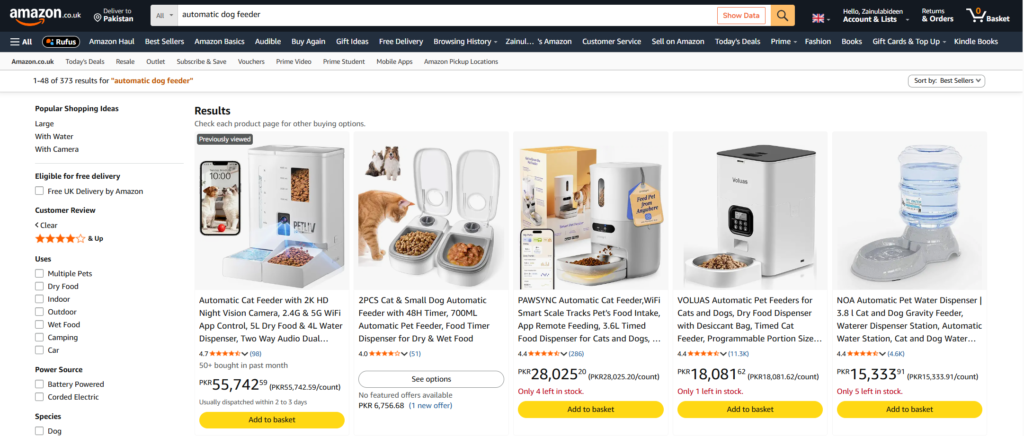
Use filters after the search results appear. First, set the customer rating to 4 stars and above. Then, apply price filters based on your budget. If you need app control, search for a WiFi feeder. If you want a simple timer feeder, search for a programmable pet feeder. Also check the product page for features like battery backup, portion control, hopper capacity, and a removable bowl.
The Amazon Choice or Best Seller badge can be a helpful signal, but don’t buy based on the badge alone. Be sure to read recent product reviews, especially 1-star and 3-star reviews. This is where you’ll find real problems, like WiFi disconnecting, kibble jamming, the app being slow, or inaccurate portion sizes.
You can create a shortlist of 3 to 5 feeders. Then search those product names on YouTube and look for real user reviews. Dog Feeders Video reviews can give you a better idea of the feeder’s actual size, sound, dispensing speed, bowl design, and app setup. Sometimes product photos look perfect, but videos can reveal that the feeder isn’t suitable for your dog’s size or feeding style.
When making the final choice, consider your dog’s size, kibble size, feeding routine, and budget. If your dog is a large breed, hopper capacity and bowl size are important. If your dog is a fast eater, portion control and a slow feeding schedule will be helpful. If your schedule is unpredictable, a WiFi feeder may be better. By comparing reviews, features, and budget, you can choose the best automatic dog feeder for your dog.
How to choose the right automatic dog feeder
Choosing a feeder depends on some practical questions. Work through these questions, and usually the right option becomes clear.
Does your dog eat dry food only?
Every feeder on this list works with dry kibble. Most feeders can’t handle wet food, semi-moist food, or raw food. If your dog eats primarily wet food, finding an automatic feeder will be harder. You’ll need a feeder with a refrigerated compartment, and those are rare and expensive.
So before spending money, ask yourself honestly whether this device can be used with your dog’s actual diet.
If you’re still deciding what to feed your dog, check out our dog food ingredients guide. This will give you an idea of what a good dry kibble should contain. Quality dry food makes automatic feeding much more practical.
How big is your dog?
Hopper capacity and bowl size both matter. A Chihuahua that eats 40g per meal can go weeks without a hopper refill in most models. A Rottweiler that eats 350g per meal will empty a standard hopper in just a few days. So be realistic about how often you’re willing to top up the feeder.
Bowl width also matters. Large breeds with broad muzzles need a wider bowl to eat comfortably. Some feeders come with removable bowls, which means you can swap in a bigger bowl if needed. Before buying, check whether the bowl is standard size or not.
Do you actually need WiFi?
WiFi is useful. But many people buy WiFi feeders and end up using them like non-WiFi models. They set the schedule once and then never open the app again. If you’re likely to use it this way, save money and buy Wopet. For daily use, voice recording is a better feature than app control, if you don’t touch the app at all.
WiFi matters when you want to adjust feeding times for work, your schedule changes unexpectedly, or you want notifications confirming meals have been dispensed. If your routine is fixed and you’re always home until dinner time, smart features are more decorative.
How many dogs do you have?
Any feeder on this list will work fine for one dog. But with two or more dogs, the equation changes. If both dogs eat the same food and the same portions, a standard hopper feeder with separate bowls may work.
But if they eat different foods or different amounts, or one dog steals the other’s food, you’ll need either two separate feeders or a microchip feeder like SureFeed.
Programming two PetLibros independently will cost less than a single Whisker Feeder-Robot, and give you more flexibility.
What’s your budget?
You can get a basic programmable feeder for under £50. Good WiFi models usually cost between £80 and £150. Premium options can go for £200 and £300. The SureFeed Microchip Connect costs around £150 and £180.
If portion precision matters, spend a little more than you think. If you just need something that drops food at the right time and doesn’t mind fancy apps, spend less. The sweet spot for most UK dog owners is the £80 to £120 range, where both PETLIBRO and PETKIT fit.
Setting up and troubleshooting your automatic feeder
The setup process for most WiFi feeders is similar. First, plug in the feeder, download the app, connect to your 2.4GHz WiFi network, and pair the device. Some newer models also support 5GHz, making setup easier if your phone and router are on the same band.
Place the feeder where your dog already associates food. Moving the dog’s feeding station can cause confusion, especially for older dogs who rely on routine. If your dog currently eats in the utility room, keep the feeder there. Don’t move it to the kitchen just because it looks better there.
When you first set up, test dispensing without food. Run 2 or 3 cycles to confirm the mechanism is working and the timer is correct. Then add a small amount of kibble and run another test cycle. Watch the portion size to confirm it matches the amount set in the app.
Common setup problems and fixes
- WiFi won’t connect: The most common reason is that you’re trying to connect to a 5GHz network. Most feeders require 2.4GHz. Check your router settings and make sure both bands are enabled. Some routers use the same network name for both bands, which can confuse the setup process. Temporarily disabling 5GHz during setup often fixes this issue.
- App won’t find feeder: Make sure Bluetooth is enabled on your phone. Most feeders use Bluetooth for initial pairing, then switch to WiFi. Keep your phone within 1 to 2 meters of the feeder during setup.
- Portions are inconsistent: Kibble size matters. Too small kibble can pass through the mechanism like sand. Too large kibble can clog. Most feeders work best with kibble 5mm to 15mm in diameter. If your kibble is outside this range, try mixing it with more standard-sized kibble, or consider a different feeder with a larger dispensing chute.
- Dog repeatedly knocking the feeder over: Place the feeder against a wall and consider placing a non-slip mat underneath. Some dogs become excited by the sound of the motor and jostle the unit. Heavier feeders like PetSafe and Whisker are more resistant to this issue.
Can automatic feeders help with weight management?
Yes, but with a few caveats. An automatic feeder is a tool for portion control, and portion control is only one part of weight management. It doesn’t replace exercise, veterinary guidance, or the right food choices.
For weight management, an automatic feeder essentially does this: Measures the same portion every time. Humans are very poor at measuring honestly consistent portions. Studies have shown that people often underestimate how much they’re serving, especially when using scoops instead of weighing scales. If the dispenser dispenses exactly 150g at every meal, this variable is completely eliminated.
The scheduling aspect also helps. Free-feeding, i.e., tossing food into an open bowl all day, is one of the biggest contributors to canine obesity. Automatic feeders that deliver set portions at set times eliminate free-feeding by design. Your dog eats when the feeder delivers food, not whenever it passes by the open bowl.
Some apps track feeding history, so you and your vet can review exactly what your dog ate over the past week or month. This data is genuinely useful during weight management consultations.
But limitations arise here. An automatic feeder doesn’t know if your dog received treats during the day, stole food from the kitchen counter, or finished another dog’s meal. It only controls the food it dispenses. If you’re giving your dog three digestive biscuits as treats on top of regular meals, the feeder’s precision becomes irrelevant.
FEDIF nutritional guidelines provide useful reference points for daily calorie intake based on the dog’s weight and activity level. Your vet can help calculate the correct portion size. Once you know those numbers, an automatic feeder is an excellent way to follow them consistently.
If your dog is significantly overweight, start with a vet consultation instead of trying to estimate portions by purchasing a feeder. Both the Blue Cross and the RSPCA publish useful guidance on canine weight management, which is worth reading before making changes to a dog’s diet.
UK-specific buying advice
UC Buerus Automatic Dog Feathers often get stuck on things while shopping.
Plug voltage and power
UK mains voltage is 230V at 50Hz. Feeders sold through Amazon UK or UK retailers should come with the correct UK plug. However, if you’re buying directly from the manufacturer’s website, especially from Chinese brands like PETKIT or Wopet, double-check that the listing clearly mentions a UK 3-pin plug.
Some products ship with EU plugs, and the seller expects you to use an adapter. Technically, this isn’t compliant with UK electrical safety standards.
If the product arrives with a non-UK plug, don’t use the cheap adapter. Either return the product or have the plug replaced by a qualified electrician. It’s not worth risking a fire to save a few pounds.
WiFi connectivity
UK home internet is generally reliable, but coverage can still be patchy in rural areas. If the WiFi signal is weak where you want to place the feeder, consider a WiFi extender or mesh network.
If the feeder fails to connect to WiFi, it defaults to its last programmed schedule, so your dog will continue to receive food. But you lose remote control and notifications until connectivity is restored.
Delivery times
Amazon UK Prime delivers most feeders within 1 to 2 days. Purchasing directly from manufacturers can result in delivery times of 7 to 14 days, especially for brands that ship from outside the UK. PETLIBRO and PetSafe both have UK distribution, so delivery times are faster. PETKIT and Wopet may be slower depending on stock levels.
Some shipments from EU-based retailers have experienced delays since Brexit. Please check estimated delivery times before ordering, especially if you need the feeder by a specific date.
Customer support and warranty
PetSafe has UK-based support. PETLIBRO also has a UK presence. PETKIT and Wopet provide support mostly via email and online chat, which can be slower and often occur in different time zones. Whisker Feeder-Robot support is US-based, meaning responses arrive in the middle of the UK night.
UK consumer law gives you strong protections for warranty claims, regardless of where the product is sold. If the feeder develops a fault within the first 6 months, the retailer is responsible for repair or replacement. Keep your proof of purchase safe.
Common problems and fixes
Kibble jamming
This is the most common issue with automatic feeders. Kibble gets jammed in the dispensing mechanism, causing meals to be missed, and your dog to go hungry. The fix is usually simple: check if your kibble size is within the feeder’s recommended range. If it’s within the size range and still jamming, try breaking up larger pieces or switching to a slightly smaller kibble. Some feeders have an anti-jam button or clearing mechanism that you can trigger from the app.
Moisture is also a cause. If kibble remains in the hopper for weeks, especially in humid environments, it can clump and jam. Use the desiccant cartridges that come with the PETKIT and PETLIBRO models, and don’t overfill the hopper if your dog eats slowly.
The dog figured out how to get extra food
Some clever dogs learn that hitting the feeder with their paw or triggering a mechanism can dispense extra kibble. If this is the case, move the feeder to a position where the dog cannot easily reach the dispensing chute. Placing the feeder in a corner or against a wall helps.
PETLIBRO and PetSafe both have sealed dispensing chutes that resist this behavior. Wolfpets are more vulnerable in this case.
App notifications have stopped
Check that app notifications are enabled in your phone settings. This seems obvious, but both iOS and Android sometimes reset notification permissions after system updates.
Also check that the feeder is still connected to WiFi. A solid LED indicator usually confirms connectivity, but be sure to check the manual for your specific model.
Feeder stops working after a power cut
If the feeder was running on mains power and backup batteries were not installed, saved settings would be lost during a power cut. You would have to reconnect to WiFi and reprogram the schedule.
It’s tedious, but simple. The lesson is: always install backup batteries, even if you think power cuts are unlikely in your area.
Multiple dogs fighting over one feeder
A standard feeder dispenses food into an open bowl that any dog can access. If you have two dogs, the faster eater will dominate.
Your options are: buy two feeders, switch to a microchip feeder, or supervise mealtimes. Two PETKIT Fresh Element Solos cost less than a Whisker Feeder-Robot, and each dog gets their own programmed portions.
Where to buy automatic dog feeders in the UK
Amazon UK is the most convenient option. Fast delivery, easy returns, and genuine buyer reviews are available. Search for automatic dog feeders on Amazon UK and use filters like average rating and price to narrow down your options.
Pet supermarkets like Pets at Home sometimes stock feeders, especially PetSafe models. The advantage is that you can see the product in person before purchasing. The disadvantage is that the range is limited and prices may be higher than online.
Buying direct from manufacturers can sometimes be cheaper, especially when brands run promotions. PETLIBRO frequently offers discount codes on its website. PETKIT sometimes has flash sales. If you’re not in a hurry, you can sign up for email newsletters.
Specialist pet retailers like VetUK and Monster Pet Supplies carry a selection of automatic feeders, with UK customer support and proper returns policies.
Wherever you buy, be sure to check the return policy. Automatic feeders are one of those products where you’ll only really know if it suits your dog when you try it. The 30-day return window gives you plenty of time to test it thoroughly.
Final thoughts
After testing these feeders for almost 2 years, my pick for most UK dog owners is the PETLIBRO Granary WiFi Feeder. It hits the sweet spot of capacity, app quality, portion precision, and price. It works reliably, the company has a UK presence, and it handles the kibble sizes that most of the best dry dog food UK brands sell.
If budget is your main concern, the Wopet Basics handles it well, and the voice recording feature is a genuinely useful bonus for anxious dogs. If you want premium build quality and cost isn’t an issue, the Whisker Feeder-Robot is the best hardware on this list. And if you’re dealing with food stealing in a multi-dog household, the SureFeed Microchip Connect is the only option that truly solves this problem.
Whichever you choose, pair it with quality food. A Precise feeder dispensing poor-quality kibble is a waste of precision. If your dog falls outside the standard adult bracket, our senior dog food guide and puppy food guide cover specific life stages.
The right automatic feeder may not replace you at mealtimes. But when life gets in the way, it gives you one less thing to worry about. And for most dog owners I’ve spoken to, this peace of mind alone is worth the investment.
Frequently asked questions
Can automatic dog feeders work with wet food?
Most automatic feeders are designed for dry kibble only. Wet food clogs dispensing mechanisms and spoils quickly at room temperature. Some premium models claim to handle semi-moist food, but even they struggle with standard tinned or pouched wet food.
If your dog eats exclusively wet food, automatic feeding becomes difficult. Your best option may be the SureFeed Microchip Connect, which seals wet food between meals to help keep it fresh. You’ll still have to manually refill the food, but the lid keeps the food protected.
Will my dog be scared of the automatic feeder?
Some dogs are startled by the motor noise the first few times the feeder dispenses food. This is normal and usually resolves within a few days. Start by running the feeder without food while you stand next to it, so your dog associates the sound with you and the feeding area. Then add a small amount of food. Most dogs overcome any nervousness within a week, especially once they realise the noise means dinner. The Wopet’s voice recording feature is specifically designed to help with this transition.
How often do I need to clean an automatic dog feeder?
The bowl should be washed daily, just like a normal food bowl. The hopper and dispensing mechanism need to be cleaned every 2 to 4 weeks. Empty the hopper completely, wipe it with a damp cloth, and let it dry before refilling.
Check the dispensing chute for kibble dust and residue, as this can build up over time and cause clogging. Most models have removable parts, which simplify this process. Avoid using harsh chemicals. Warm water and mild soap are sufficient.
What happens if the WiFi goes down?
The feeder continues to function. WiFi connectivity only matters for remote control, app adjustments, and push notifications. The feeding schedule is saved locally within the device.
If your WiFi drops, the feeder will continue to dispense meals at the programmed times. You simply cannot change the schedule or check the feeding status until connectivity is restored.
Some models reconnect automatically. Some require manual reconnection via the app.
Can I use an automatic feeder for a puppy?
Yes, but with some considerations. Puppies usually need 3 to 4 meals per day, along with specific puppy food. Most automatic feeders can handle multiple daily meals, so the scheduling side is fine. Check our puppy food guide for appropriate foods.
The main concern is that puppies are still growing, and their portion needs change frequently. You’ll need to adjust feeder settings regularly, so WiFi control is more useful than a basic timer. PETLIBRO’s option to set up to 15 meals per day provides a lot of flexibility for puppy feeding schedules.
Are automatic feeders safe to leave running when I’m away?
Yes, provided you’ve set up the feeder correctly. Always install backup batteries so the feeder continues to work during power outages. Don’t overfill the hopper, as kibble can spoil if left for weeks, especially in warm weather.
Start with short trips, like 1 night away, and use it for longer absences once you’re confident the feeder is reliable. Still, be sure to ask someone to check on your dog. An automatic feeder handles the food, but it doesn’t replace human supervision for water, exercise, and companionship.
How long does the food stay fresh in the hopper?
Dry kibble in a sealed hopper stays fresh for roughly 2 to 3 weeks. After that, the fats in the food begin to oxidize and the kibble can become stale.
Use the desiccant cartridges that come with PETKIT and PETLIBRO models. Do not mix fresh kibble with old kibble. Empty the hopper completely before refilling.
If your dog eats less than half the hopper’s capacity per week, consider a smaller feeder or fill the hopper less fully each time.
Can automatic feeders help a dog with separation anxiety?
These can contribute to an anxiety-reducing routine, but will not resolve separation anxiety on their own. Dogs with separation anxiety benefit from predictable routines. A feeder that dispenses meal at the same time every day, even when you are not home, can be a part of that predictability.
Woppet’s voice recorder is an especially useful feature here, as hearing your voice at mealtimes can be comforting to the dog. For serious separation anxiety, combine the feeder with other strategies: puzzle toys, background noise, and gradual desensitization. The PDSA publishes practical advice on managing separation anxiety, which I recommend reading.
What kibble size works best in automatic feeders?
The sweet spot is 5mm to 15mm in diameter. Most standard dry dog foods fall within this range. Kibble smaller than 5mm can escape the dispensing mechanism too quickly, causing oversized portions. Kibble larger than 15mm can jam.
If your dog eats unusually shaped or sized kibble, test a small amount in the feeder before filling the entire hopper. Kibble sizes from brands like Royal Canin, Harringtons, and Burns usually work well in most automatic feeders.