
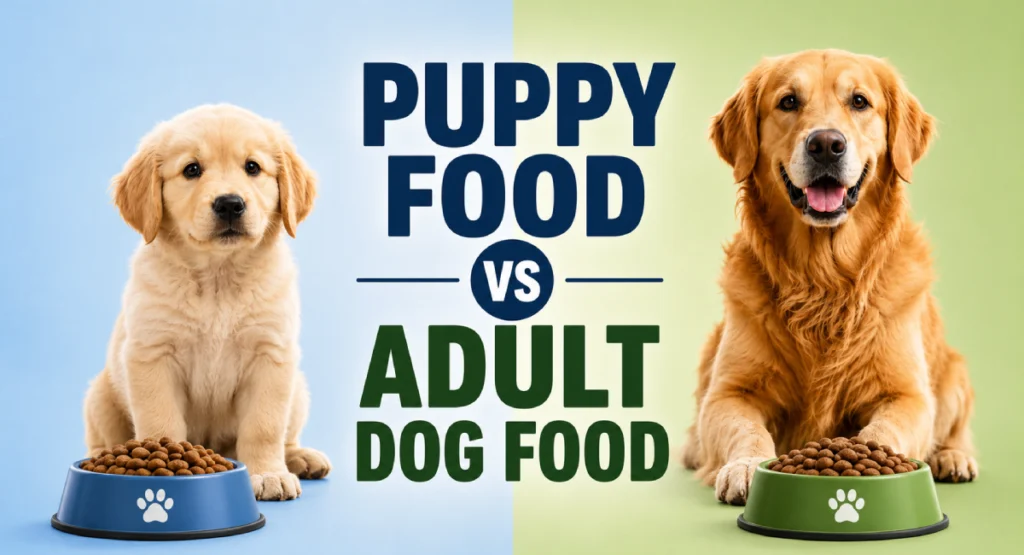
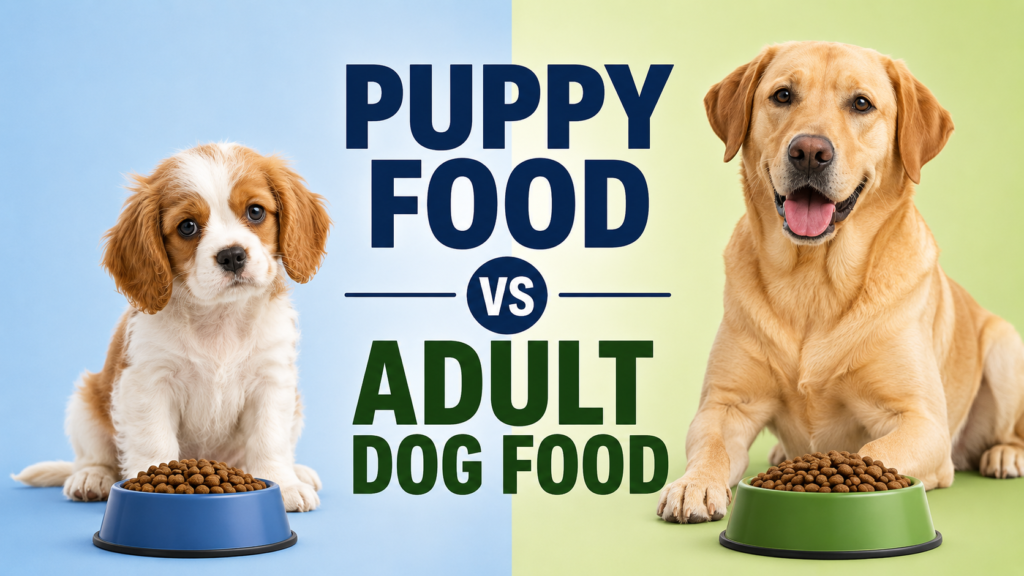
Puppy Food vs Adult Dog Food
If you’ve recently brought home a new puppy, one of the first decisions is what to feed it.
When you go shopping for dog food,
almost immediately, you’ll notice a separate section in the pet food aisle labeled “puppy food,” which is different from the standard adult dog food you’re probably already familiar with. This naturally raises a question: What’s the actual difference between puppy food and adult dog food, and does it really matter?
Yes, it very much does. Puppy food and adult dog food are formulated for fundamentally different nutritional requirements. Feeding the wrong life-stage food, whether a puppy is eating adult food or an adult dog is eating puppy food, can cause real health consequences over time.
In this guide, we’ll break down the key differences between puppy food and adult dog food, explain the science behind canine life-stage nutrition, help you understand when to make the switch, and answer common questions UK dog owners have on this topic. Whether you’re a first-time puppy owner or an experienced dog lover looking for a refresher, this article covers everything you need to know.
The Fundamental Difference: Why Puppy Food Exists
Puppies Are Not Miniature Adults
It may seem tempting to think of a puppy as just a smaller version of an adult dog, but biologically speaking, this is simply not true. A puppy’s body is going through an extraordinary growth and development phase, requiring a completely different nutritional profile than that of a fully grown dog.
Observe the speed of development: A medium-breed puppy reaches approximately half of its adult body weight by just 4 to 5 months of age. Large or giant breed puppies can gain more than 100 grams per single day during their peak growth phase. This rapid development affects every system of the body: skeletal structure, muscles, organs, immune system, and especially the brain.
The European Pet Food Industry Federation (FEDIAF), which sets nutritional standards for pet food in Europe including the UK, recognizes distinct nutritional profiles for growth i.e. puppy, adult maintenance, and senior dogs. These are not marketing categories. They are scientifically determined requirements based on decades of veterinary and nutritional research.
The Growth Phase Requires Different Nutrient Ratios
During the growth phase, puppies require a much higher concentration of protein, fat, calories, and specific minerals than adult dogs. Their metabolic rate is higher, their digestive system is still maturing, and their body is building the foundation for lifelong health.
Calcium, for example, must be carefully balanced for growing puppies. Too little calcium can cause skeletal deformities, but too much calcium can be equally harmful, especially in large breed puppies, which are more susceptible to developmental orthopedic diseases. This precise balance is one of the main reasons why puppy-specific formulations exist.
Brain development is also a critical factor. The omega-3 fatty acid DHA (docosahexaenoic acid) is essential for cognitive and visual development in puppies. Adult dogs also benefit from omega-3s, but the required concentration is much higher during the first year of life. Puppy foods are enriched with DHA to support neurological development.
How Puppy Food Was Developed
The concept of life-stage pet nutrition is relatively modern in historical terms. For much of the 20th century, dogs were fed generic formulations, often based on ingredients that were cheapest and most readily available.
It wasn’t until the 1960s and 1970s that veterinary nutritionists began to recognize the serious differences between the needs of growing animals and adult animals.
The British Veterinary Association (BVA) and organisations like the PDSA have since championed the importance of life-stage appropriate nutrition as a cornerstone of preventive veterinary care. Today, FEDIAF guidelines form the backbone of European pet food regulation, ensuring that foods labelled for specific life stages meet rigorous nutritional standards.
Nutritional Comparison: Puppy Food vs Adult Dog Food
This is the heart of the matter. The table below provides a comprehensive side-by-side comparison of the key nutritional differences between puppy food and adult dog food. Understanding these differences is essential for making informed feeding decisions for your dog.
| Nutrient | Puppy Food | Adult Dog Food | Why It Matters |
|---|---|---|---|
| Protein | 25–32% | 18–28% | Growth and muscle development — puppies need more building blocks |
| Fat | 10–25% | 8–18% | Energy for rapid growth and brain development |
| Calcium | 0.8–1.5% | 0.5–1.2% | Bone development — requires careful balance, especially in large breeds |
| Phosphorus | 0.7–1.3% | 0.4–1.0% | Works alongside calcium for healthy bone and teeth formation |
| DHA / Omega-3 | Higher | Lower | Critical for brain, eye, and cognitive development in puppies |
| Calories per Cup | Higher | Lower | Puppies need more energy per kilogram of body weight |
| Fibre | Moderate | Higher | Adult dogs benefit from more fibre for digestive health and satiety |
| Glucosamine / Chondroitin | Found in large breed puppy food | Commonly in senior and joint formulas | Joint health support during rapid growth phases |
| Vitamins A, D, E | Higher levels | Standard levels | Support immune system, vision, skin, and overall growth |
| Calorie Density (kcal/100g) | 360–420 kcal | 300–380 kcal | Puppies burn more energy proportionally and need calorie-dense food |
Let us now examine each of these nutritional differences in greater detail.
Protein: The Building Blocks of Growth
Protein is arguably the most significant difference between puppy and adult dog food. Puppies require a minimum of 25% protein on a dry matter basis, compared to around 18% for adult dogs, according to FEDIAF guidelines. High-quality animal proteins such as chicken, lamb, salmon, and turkey provide the essential amino acids that puppies need for tissue growth, muscle development, and enzyme production.
The quality of protein matters as much as the quantity. A puppy food that lists a named meat source as its first ingredient (e.g., “fresh chicken” rather than “meat meal”) is generally preferable. For a detailed breakdown of protein requirements and our top recommendations, see our guide to the best puppy food in the UK.
Fat: Energy and Brain Development
The fat content of puppy food is usually between 10% and 25%, which is much higher than the 8% to 18% found in most adult dog foods. This isn’t just to make the food more tasty, although it certainly helps with taste. Fat is the most energy-dense nutrient, providing approximately double the calories per gram compared to protein or carbohydrates.
Puppies need this extra energy because their bodies are running almost marathons every day. The body is building bones, muscles, organs, and neural tissue at the same time. Fats carry fat-soluble vitamins, such as A, D, E, and K, and provide essential fatty acids that the body cannot synthesize on its own. Omega-3 fatty acids, especially DHA, are more concentrated in puppy food because they play a vital role in cognitive and retinal development.
Calcium and Phosphorus: The Skeleton’s Foundation
Calcium and phosphorus content is one of the most critical nutritional differences in puppy food and must be carefully considered. Puppies require more calcium than adults because their skeleton is actively growing. However, the balance between calcium and phosphorus is considered more important than absolute amounts.
FEDIAF recommends a calcium-to-phosphorus ratio of approximately 1.2:1 to 1.4:1 for puppies. Getting this ratio wrong can cause serious consequences. Too little calcium can lead to nutritional secondary hyperparathyroidism and skeletal weakening. Too much calcium can also be a problem, especially when owners supplement calcium tablets with balanced puppy food.
This can cause developmental orthopedic diseases, including osteochondrosis and hypertrophic osteodystrophy, especially in large and giant breed puppies.
For this reason, large breed puppy foods exist as a separate subcategory. These contain controlled calcium levels, usually capped at around 1.2-1.3%, so that bone growth is not excessively rapid.For more on this topic, read our dedicated guide to large breed puppy food.
DHA and Omega-3 Fatty Acids
Docosahexaenoic acid (DHA) is an omega-3 fatty acid that plays an important role in puppy brain and eye development. Research has shown that puppies fed DHA-enriched diets have better trainability, improved problem-solving ability, and improved retinal function compared to puppies fed standard diets.
Most premium puppy foods now include measurable levels of DHA, usually sourced from fish oil or algal oil. Its concentration is significantly higher than in standard adult maintenance foods, as DHA has its greatest effect during that critical developmental window, primarily the first 12 months of life.
Calorie Density
Puppy food is more calorie-dense than adult food. Typically, puppy food provides 360 to 420 kilocalories per 100 grams, while adult formulas range from around 300 to 380 kcal per 100 grams. This higher calorie density is for practical purposes: puppies have smaller stomachs than adults, but they require more calories per kilogram of body weight.
A growing puppy may require almost double the calories per kilogram of body weight compared to an adult dog of the same breed. If they are fed adult food, they will have to eat a larger volume, which their smaller digestive system may struggle to process efficiently. This is why proper puppy feeding guidelines by age are so important.
Vitamins and Minerals
Puppy foods contain higher levels of some vitamins than adult foods. Vitamin A supports vision and immune function, Vitamin D helps with calcium absorption and bone mineralization, and Vitamin E, as a powerful antioxidant, protects developing cells from oxidative damage.
The precise levels of these vitamins are balanced to support the rapid cellular turnover of the growth phase, but not increase the risk of toxicity.
Can Puppies Eat Adult Dog Food?
This is one of the most frequently asked questions by new puppy owners, and the answer requires nuance.
The Short Answer
Occasionally, in an emergency, a puppy can eat adult dog food without immediate harm. If you run out of puppy food and cannot get to a shop immediately, feeding your puppy a portion of adult food for one or two meals will not cause lasting damage. However, feeding adult dog food as a puppy’s regular, long-term diet is not recommended and can lead to significant health problems.
What Happens If Puppies Eat Adult Food Regularly?
When puppies are fed adult dog food over an extended period, several nutritional deficiencies and health issues can develop:
- Insufficient protein intake: Without adequate protein, a puppy’s muscle development will be compromised, potentially leading to poor body condition, weakness, and delayed growth.
- Inadequate calcium for bone growth: Adult dog food contains lower calcium levels than what growing puppies require. Over time, this can result in weakened bones, skeletal abnormalities, and an increased risk of fractures.
- Energy deficit: The lower calorie density of adult food means puppies may not consume enough energy to support their rapid growth rate, potentially leading to stunted development.
- Lower DHA levels: Reduced omega-3 intake during the critical brain development window may affect cognitive development and trainability.
- Vitamin deficiencies: Lower levels of vitamins A, D, and E can compromise immune function, vision, and cellular health during a vulnerable period.
The Calcium Risk: A Closer Look
The calcium issue requires special attention, as it can create problems from both sides. Adult food may not provide enough calcium for a growing puppy, but simply adding calcium supplements to adult food is not the solution either.
Excessive calcium intake, especially in large breed puppies, is clearly linked to developmental orthopedic diseases. The RSPCA specifically warns against over-supplementation and recommends feeding commercially produced, life-stage-appropriate puppy food, formulated to provide correct calcium levels, without the need for extra supplements.
When Might It Be Temporarily Okay?
If you encounter a genuine emergency, for example, you are traveling and don’t have access to puppy food, feeding the puppy adult food for 24 to 48 hours will usually not cause harm.
But you should transition back to puppy food as soon as possible. For guidance on making dietary changes safely, see our article on how to switch dog food safely.
Can Adult Dogs Eat Puppy Food?
The reverse question is equally valid: can an adult dog eat puppy food? Again, the answer requires some nuance.
The Short Answer
It’s generally fine for adult dogs to eat puppy food occasionally, but it shouldn’t be their long-term diet. Puppy food is essentially a nutrient-dense and higher-calorie formula. And for a dog whose growth phase is complete, these extra nutrients are not only unnecessary, but can also be actively harmful over time.
Risks of Feeding Puppy Food to Adult Dogs
- Weight gain and obesity: The higher calorie and fat content of puppy food means adult dogs consuming it regularly are likely to gain weight. Obesity is one of the most significant health issues facing UK dogs, with the PDSA estimating that up to 40% of dogs are overweight. Even a modest calorie surplus sustained over months can lead to significant weight gain.
- Excessive calcium intake: Adult dogs do not need the elevated calcium levels found in puppy food. Over time, excess calcium can place additional strain on the kidneys and may contribute to the formation of urinary stones in susceptible breeds.
- Joint stress: Carrying excess weight from overconsumption of calories places unnecessary stress on a dog’s joints, potentially exacerbating or accelerating conditions like osteoarthritis.
When Is It Okay?
There are certain situations where feeding puppy food to an adult dog may be appropriate, at least temporarily:
- Underweight or recovering dogs: A dog recovering from illness, surgery, or prolonged malnourishment may benefit temporarily from the higher calorie and protein content of puppy food.
- Working dogs: Highly active working dogs — such as sheepdogs, gundogs, and agility competitors — may have elevated energy requirements that puppy food can help meet, though purpose-formulated performance foods are generally a better option.
- Senior dogs needing extra nutrition: Some elderly dogs who are struggling to maintain weight may benefit from the nutrient density of puppy food. However, specialised senior formulations like those in our guide to the best senior dog food are usually more appropriate, as they balance higher calories with joint-supporting ingredients and controlled mineral levels.
How Long Is Too Long?
As a general guideline, an adult dog eating puppy food exclusively for more than two to three weeks is likely consuming more calories and nutrients than necessary. If you find yourself in a situation where puppy food is all you have available, consider feeding slightly smaller portions to compensate for the higher calorie density, and transition to appropriate adult food as soon as possible.
Types of Puppy Food Explained
Not all puppy food is the same. Understanding the different types available will help you make the best choice for your puppy. Here is a brief overview of the main categories:
Complete vs Complementary
“Complete” puppy food is formulated to provide your puppy with all the essential nutrients as its sole diet. It is nutritionally balanced and self-sufficient.
“Complementary” food, on the other hand, is food designed to be fed with other foods, such as biscuits mixed with wet food. Always check the label. If it doesn’t say “complete,” it is complementary and should not be your puppy’s only food source.
Wet vs Dry Puppy Food
Dry puppy food, also known as kibble, is the most popular choice in the UK. It’s convenient, may offer dental benefits due to the crunching action, and usually offers better value per serving.
Wet puppy food has a higher moisture content, which can help with hydration, and is also more tasty for fussy eaters. Many owners choose a combination of the two. For in-depth reviews, see our guides to the best dry dog food in the UK and the best wet puppy food.
Grain-Free vs Grain-Inclusive
Grain-free puppy foods replace grains, such as wheat, rice, and maize, with alternative carbohydrate sources, such as sweet potato, peas, and lentils. Some puppies may have genuine grain allergies, though true food allergies are relatively rare. However, grain-free diets generally offer no nutritional advantage for puppies.
The UK Veterinary Surgeons General has also issued guidance regarding a potential link between grain-free diets and canine dilated cardiomyopathy (DCM), so it’s best to consult your vet before choosing a grain-free option. Read our detailed comparison in our grain-free puppy food guide.
Large Breed vs Small Breed Puppy Food
The difference between large breed and small breed puppy food is one of the most important nutritional differences within the puppy food category. Large breed puppies, i.e. those expected to weigh over 25 kg at adulthood, require controlled growth rates to protect their developing joints.
Their food is lower in calcium, has controlled phosphorus levels, and includes specific joint-supporting nutrients. Small breed puppies mature faster and have a higher metabolic rate, so their food is usually more calorie-dense and the kibble size is smaller. Our large breed puppy food article covers this in detail.
All Life Stage Dog Food: Is It a Good Compromise?
Many dog food brands offer “all life stages” or “all life stages complete” formulations that claim to be suitable for puppies, adults, and senior dogs alike. But is this too good to be true?
What Does “All Life Stages” Mean?
An all life stages dog food is formulated to meet the nutritional requirements for growth (puppy) as well as adult maintenance. In practice, this means the food must meet the more demanding puppy nutritional standards — higher protein, higher calories, and elevated mineral levels. FEDIAF does recognise “all life stages” as a valid nutritional category, but with specific compositional constraints.
Pros of All Life Stages Food
- Convenience: If you have multiple dogs of different ages, an all life stages food simplifies feeding considerably.
- Cost-effective for multi-dog households: Buying one food instead of several can reduce costs.
- Guaranteed minimum standards: Because it must meet growth requirements, an all life stages food will always provide adequate nutrition for puppies.
Cons of All Life Stages Food
- Not optimal for any single life stage: By trying to serve everyone, all life stages food may not be the best choice for any particular dog. Adult dogs eating it will consume more calories and minerals than they need. Puppies will receive adequate nutrition but may not get the targeted DHA, calcium balance, or calorie density of a purpose-formulated puppy food.
- Weight management challenges: Adult dogs, especially less active ones or senior dogs, may gain weight on all life stages food.
- Lack of large breed specificity: Most all life stages foods are not differentiated for large breed puppies, who have very specific calcium requirements.
Our Recommendation
For a single puppy, we strongly recommend feeding a dedicated, life-stage-appropriate puppy food rather than an all life stages formulation. The targeted nutrition will better support your puppy’s growth and development. All life stages food can be a reasonable option for multi-dog households where feeding separate foods is impractical, but you should monitor all dogs’ body condition carefully and adjust portions accordingly.
When Should You Make the Switch?
The timing of the transition from puppy food to adult food depends primarily on your dog’s breed size. Different breeds mature at different rates, and switching too early can deprive a still-growing dog of essential nutrients, while switching too late can lead to unnecessary weight gain.
| Breed Size | Expected Adult Weight | When to Switch to Adult Food |
|---|---|---|
| Toy / Small Breeds | Under 10 kg | Around 9–12 months |
| Medium Breeds | 10–25 kg | Around 12 months |
| Large Breeds | 25–45 kg | Around 15–18 months |
| Giant Breeds | Over 45 kg | Around 18–24 months |
These are general guidelines — individual dogs may mature slightly faster or slower than average. For a comprehensive, breed-by-breed breakdown, please read our detailed guide on when to switch from puppy to adult dog food. It covers everything from the physical signs of maturity to the safest gradual transition method.
How to Read Dog Food Labels: Puppy vs Adult
Understanding how to read and interpret dog food labels is an essential skill for any responsible dog owner. Here is what to look for when distinguishing between puppy and adult formulations:
Life Stage Identification
By law in the UK, pet food labels must clearly state the intended life stage. Look for phrases such as:
- “Complete pet food for puppies”
- “For growth and lactation”
- “Complete pet food for adult dogs”
- “For adult maintenance”
If the label says “complete pet food for all life stages,” it meets the growth standard and is technically suitable for puppies — but as discussed above, may not be optimal.
The “Complete” Claim
The word “complete” is legally defined in the UK and EU. A complete pet food must, by law, contain all the nutrients required by the target species and life stage in the correct proportions. A food labelled as “complementary” does not meet this standard and should only be fed as part of a broader diet. This distinction is particularly important for puppies, whose nutritional needs are more precise than those of adult dogs.
FEDIAF Guidelines Compliance
Reputable manufacturers will reference FEDIAF nutritional guidelines on their packaging or website. This indicates that the food has been formulated according to the latest European nutritional standards for the specified life stage. If a brand does not reference FEDIAF (or the equivalent AAFCO standards for internationally sourced products), it may be worth questioning the rigour of their formulation process.
Guaranteed Analysis
The guaranteed analysis provides the minimum (or sometimes typical) percentages of key nutrients: protein, fat, fibre, ash, and moisture. While this is a useful starting point for comparison, it does not tell the whole story. The quality and digestibility of the protein and fat sources matter enormously — a food with 28% protein from named meat sources is far superior to one with 28% protein that includes significant amounts of plant-based protein concentrate.
Feeding Guidelines
Puppy foods will always include specific feeding guidelines based on the puppy’s current weight and expected adult weight. These guidelines are calibrated to deliver the appropriate number of calories and nutrients for growth. Adult food feeding guidelines are calibrated for weight maintenance. Using the wrong feeding guide — for example, following adult food guidelines for a puppy — can result in significant over- or under-feeding.
Frequently Asked Questions
What happens if my puppy eats adult dog food?
A single instance of your puppy eating some adult dog food is unlikely to cause any harm. However, if an adult diet is fed consistently over weeks or months, your puppy may suffer from inadequate protein intake for muscle development, insufficient calcium for proper bone growth, lower calorie intake than needed for their rapid growth phase, and reduced DHA levels that could affect brain and eye development. Always feed a nutritionally complete puppy food as your puppy’s regular diet.
Is puppy food actually that different from adult food?
Yes. While the ingredients may look similar — both often contain chicken, rice, vegetables, and vitamins — the proportions and concentrations are fundamentally different. Puppy food contains significantly more protein, fat, calories, calcium, and DHA per serving than adult food. These differences are not arbitrary marketing decisions; they reflect the genuinely different physiological requirements of a growing animal versus a mature one.
Can I feed my 6-month-old puppy adult food?
We would not recommend it. At six months old, most puppies are still in an active growth phase — particularly medium, large, and giant breeds. Small breed puppies may be approaching maturity at six months, but even they benefit from the continued nutritional support of puppy food until at least nine to twelve months of age. Switching to adult food at six months risks depriving your puppy of the nutrients they still need for healthy development.
Why is puppy food more expensive than adult food?
Puppy food tends to be more expensive for several reasons: higher concentrations of quality protein (meat is the most expensive ingredient), elevated levels of essential fatty acids like DHA (often sourced from premium fish oil), more precise mineral balancing requiring higher-quality ingredient sourcing, and the smaller production volumes compared to the much larger adult dog food market. The price difference reflects the genuine cost of producing a more nutrient-dense, carefully calibrated formulation.
What about all life stages food — is it good enough for puppies?
All life stages food meets the minimum nutritional requirements for growth, so it is technically adequate for puppies. However, “adequate” is not the same as “optimal.” A dedicated puppy food will typically provide better-targeted nutrition — more appropriate calcium levels, higher DHA concentrations, and calorie density better suited to a growing puppy’s needs. For the best start in life, we recommend choosing a puppy-specific food over an all life stages option.
Can a senior dog eat puppy food for extra nutrition?
While the higher protein and calorie content in puppy food might seem beneficial for a senior dog who is losing weight, there are better options available. Puppy food’s elevated calcium and phosphorus levels are not ideal for ageing kidneys, and the higher calorie density may contribute to weight gain if activity levels are low. Instead, consider a dedicated senior dog food that balances higher protein for muscle maintenance with appropriate mineral levels and joint-supporting ingredients. See our guide to the best senior dog food for tailored recommendations.
How do I know if a food is formulated for puppies?
Check the packaging for the life stage claim. Legally, dog food sold in the UK must clearly state whether it is intended for growth (puppies), adult maintenance, or all life stages. Look specifically for phrases like “complete pet food for puppies” or “for growth and lactation.” The FEDIAF guidelines statement or nutritional adequacy declaration should also reference the growth profile. If you are unsure, check the manufacturer’s website or contact their customer service for clarification.
Do small breed puppies need different food than large breed puppies?
Yes, they do. Small breed puppies (expected adult weight under 10kg) mature faster, have higher metabolic rates per kilogram of body weight, and have smaller mouths requiring smaller kibble. Their food is typically more calorie-dense to fuel their fast metabolism. Large breed puppies (expected adult weight over 25kg) need controlled calcium and phosphorus levels to prevent excessively rapid bone growth, larger kibble sizes to slow eating, and specific joint-supporting nutrients. Feeding a large breed puppy the wrong food — particularly one with excessive calcium — can lead to serious developmental orthopaedic problems.
Is wet puppy food different from dry puppy food nutritionally?
Both wet and dry puppy foods can be nutritionally complete, but they differ significantly in moisture content, calorie density, and texture. Wet puppy food typically contains 70–85% moisture, while dry kibble contains around 8–12%. This means wet food is less calorie-dense by weight, so your puppy will need to eat a larger volume to meet their calorie needs. Nutritionally, a complete wet puppy food and a complete dry puppy food should both meet the same FEDIAF growth standards. The best choice depends on your puppy’s preferences, your budget, and any specific health considerations. For reviews of both types, see our best wet puppy food and best dry dog food guides.
What is the best puppy food brand in the UK?
The “best” brand depends on your puppy’s breed size, any sensitivities they may have, and your budget. However, some brands consistently score highly in UK independent reviews. Our comprehensive best puppy food UK guide ranks the top options across all categories — dry, wet, grain-free, large breed, and sensitive stomach formulas — based on nutritional quality, ingredient sourcing, value for money, and real owner feedback.
Final Verdict
The difference between puppy food and adult dog food is not a marketing gimmick — it is a scientifically grounded distinction that reflects the fundamentally different nutritional requirements of growing and mature dogs. Puppies need more protein, more fat, more calories, carefully balanced calcium and phosphorus, and elevated levels of DHA to support their rapid physical and cognitive development. Adult dogs need a maintenance diet that sustains their health without promoting weight gain or overloading their systems with unnecessary nutrients.
Feeding your puppy a dedicated, high-quality puppy food and transitioning to an appropriate adult food at the right time is one of the most impactful decisions you can make for their long-term health. To summarise the key takeaways:
| Key Point | Summary |
|---|---|
| Is the difference real? | Yes — significantly different protein, fat, calcium, and calorie levels |
| Can puppies eat adult food? | Only in emergencies; not suitable as a long-term diet |
| Can adults eat puppy food? | Occasionally fine; risks weight gain and excess mineral intake long-term |
| When to switch? | 9–12 months (small breeds), 12 months (medium), 15–24 months (large/giant) |
| All life stages food? | Adequate but not optimal; dedicated life-stage food is preferred |
For specific product recommendations tailored to your dog’s needs, explore our comprehensive guides:
- Best Puppy Food UK — Top Picks for 2025
- Best Adult Dog Food UK — Top Picks for 2025
- When to Switch from Puppy to Adult Dog Food — Complete Guide
- Puppy Feeding Guide — How Much to Feed by Age
- How to Switch Dog Food Safely — Step-by-Step Guide
Choosing the right food for your dog at every stage of their life is one of the most important responsibilities of pet ownership. By understanding the real differences between puppy food and adult dog food, you are equipped to make informed decisions that will support your dog’s health, happiness, and longevity for years to come.